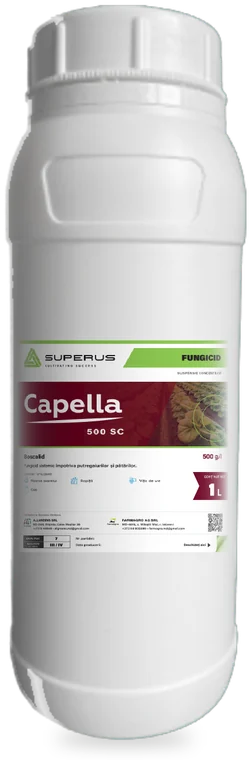
Capella 500 SC
Systemisches Fungizid gegen Fäulen und Blattfleckenkrankheiten.
 Sonnenblume
 Raps
 Weinrebe
 Aprikose
Anwendungshinweise
Kulturen, Zielorganismen und Aufwandmengen. Beachten Sie stets das Etikett des in Ihrem Land zugelassenen Produkts.
| Kultur | Zielorganismus | Aufwandmenge (l/ha) | Anwendung | Wartezeit, Tage (max. Anwendungen) | Wiederbetreten, Tage manuell (mechanisiert) |
|---|---|---|---|---|---|
| Sonnenblume | Alternaria-Blattflecken, Phomopsis-Stängelfäule | 0,5 - 0,6 | Blattspritzung während der Vegetationsperiode | 30(2) | 7(3) |
| Raps | Grauschimmel, Weißstängeligkeit / Sclerotinia-Fäule, Wurzelhals- und Stängelfäule (Phoma), Rapsschwärze | 0,4 - 0,5 | Blattspritzung während der Vegetationsperiode | 30(2) | 7(3) |
| Weinrebe | Grauschimmel | 1,2-1,4 | Blattspritzung während der Vegetationsperiode | 30(2-3) | 7(3) |
| Aprikose | Fruchtfäule | 0,4 - 0,5 | Blattspritzung während der Vegetationsperiode | 7 (2-3) | 7 (3) |
Technische Informationen
Wirkungsweise
Capella 500 SC is a systemic fungicide based on boscalid, from the carboxamide group (SDHI, FRAC 7). The active substance blocks complex II of the fungal mitochondrial respiratory chain, stopping energy production, spore germination, germ tube elongation and mycelial growth; it acts mainly preventively. It moves translaminarly and acropetally; it is effective against grey mould, white mould, Alternaria leaf spot, Phomopsis and brown rot.
Physikalisch-chemische Eigenschaften
Capella 500 SC is presented as a homogeneous suspension concentrate (SC) of light colour, containing boscalid 500 g/l. The product is not flammable and not corrosive.
Mischbarkeit
Capella 500 SC is compatible with most fungicides and insecticides, except strongly alkaline ones. Mixing or alternating with fungicides with a different mode of action is recommended. Test compatibility.
Anwendungstechnik
Sprayer: use a sprayer that ensures uniform distribution of the spray solution. Fill 1/2 of the tank with water, add the product (shaken beforehand) and, under continuous agitation, top up with water. Spray volume: 200–400 l/ha in sunflower and rapeseed; 800–1000 l/ha in grapevine and apricot.
Einschränkungen & Auflagen
The product Capella 500 SC must be used only on the registered crops and in accordance with the regulations of use. A maximum of 2 treatments per season with SDHI fungicides (FRAC 7). During flowering, treatments are carried out outside the period of active bee flight. Pollution of water bodies with spray solution must be avoided. Re-entry period: mechanised work – 3 days, manual work – 7 days.
Phytotoxizität
At the recommended doses, Capella 500 SC has no phytotoxic effect. Do not apply to wet plants or before expected rain.
Toxizität
Acute oral toxicity hazard category, human/bees: III / IV
- Toxizitätsklasse (Mensch / Bienen)
- III / IV
Sicherheit, Lagerung & Entsorgung
Einstufung & Gefahrenhinweise
Gefahrenhinweise
- H411 — Giftig für Wasserorganismen, mit langfristiger Wirkung.
- EUH401 — Zur Vermeidung von Risiken für Mensch und Umwelt die Gebrauchsanleitung einhalten.
Sicherheitshinweise
- P102 — Darf nicht in die Hände von Kindern gelangen.
- P270 — Bei Gebrauch nicht essen, trinken oder rauchen.
- P273 — Freisetzung in die Umwelt vermeiden.
- P391 — Verschüttete Mengen aufnehmen.
- P501 — Inhalt/Behälter gemäß den örtlichen Vorschriften der Entsorgung zuführen.
Sicherheitsmaßnahmen bei der Anwendung
Avoid contact with skin, eyes and clothing. Protective equipment and protective gloves must be worn during work. Use personal protective clothing. Keep work clothing separate. Adequate airing and ventilation of the workplace and storage area is required. Do not eat, drink or smoke when using this product. Hands and/or face must be washed before breaks and at the end of the working day. If medical advice is needed, have the product container or label at hand. Avoid breathing mist, vapours or spray. Do not take contaminated work clothing out of the workplace. After using the product, wash thoroughly any parts of the body that have been contaminated. Take off contaminated clothing and wash it before re-use. Read carefully and follow all instructions.
Erste Hilfe
In case of eye contact: rinse with plenty of clean water for at least 15 minutes, including under the eyelids. Remove contact lenses, if present. In case of skin contact: immediately remove contaminated clothing and wash the contaminated areas of the body with plenty of water. If irritation persists, seek medical advice. Wash contaminated clothing before re-use. If swallowed: give the casualty plenty of water to drink. Do not induce vomiting. Call a doctor immediately. If inhaled: move the casualty to fresh air. If breathing is irregular or has stopped, give artificial respiration. Seek medical attention if the casualty feels unwell. THERE IS NO ANTIDOTE; TREAT SYMPTOMATICALLY.
Lagerung & Transport
Store the product in its original, sealed packaging, in dry rooms intended exclusively for pesticides, separately from food, beverages, tobacco products and animal feed. Protect from direct sunlight. Protect from temperatures below 0°C or above +35°C. During handling, transport and storage, occupational safety measures must be taken and the product must be protected from extreme temperature variations.
Entsorgung & Dekontamination der Verpackung
Prevent any possibility of product leakage, if this can be done safely. Do not discharge the product into surface waters or sewer systems. Contain the spill, then collect the accidentally spilled product by mechanical means and place it in suitable containers for subsequent disposal as hazardous waste. After removing the product, wash the spill site with water. If the product contaminates rivers, lakes or drains, inform the competent authorities. After emptying, rinse the containers three times and add the rinse water to the spray solution. Dispose of empty containers in accordance with the regulations in force. Do not re-use empty containers for any other purpose.
Entflammbarkeit
NON-FLAMMABLE PRODUCT. The product is not explosive and has no oxidising properties. In case of fire, use the following extinguishing media: water spray, foam, dry chemical powder or carbon dioxide. Toxic gases (carbon oxides, nitrogen oxides, hydrochloric acid) may be released on burning; firefighters must wear self-contained breathing apparatus.