
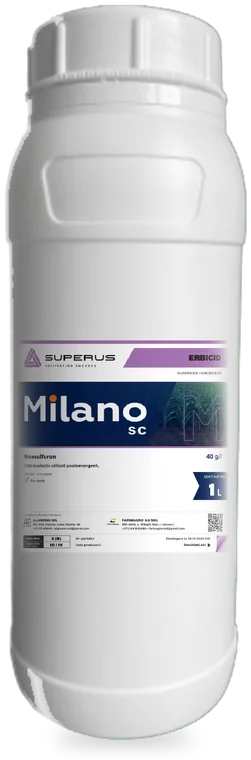
Milano SC
Herbicida selectivo de posemergencia.
 Maíz
Instrucciones de uso
Cultivos, organismos diana y dosis. Siga siempre la etiqueta del producto tal como está registrado en su país.
| Cultivo | Organismo diana | Dosis (l/ha) | Aplicación | Plazo de seguridad, días (n.º máx. de tratamientos) | Reentrada, días manual (mecanizado) |
|---|---|---|---|---|---|
| Maíz | Malas hierbas gramíneas y de hoja ancha anuales | 1,25-1,5 | Pulverización foliar del cultivo en el estado de 3–5 hojas del cultivo | - (1) | 7 (3) |
Información técnica
Modo de acción
Milano, SC is a selective herbicide whose active substance belongs to the sulfonylurea class, used post-emergence in maize for the control of annual grass and broad-leaved weeds. Its properties include rapid uptake through the leaves, translocation to the meristematic tissues and inhibition of the enzyme acetolactate synthase (ALS), which interrupts cell division and leads to the death of the weeds. The herbicide is effective against weeds such as Johnson grass, couch grass and foxtail.
Propiedades físico-químicas
Milano, SC is a homogeneous, cream-white suspension concentrate with a characteristic odour, containing nicosulfuron 40 g/l; the product is not corrosive.
Compatibilidad
Milano, SC is compatible with most pesticides, but a preliminary compatibility test is recommended for each mixture.
Técnica de aplicación
Sprayer: use a sprayer that ensures uniform distribution of the spray solution. Application: use the required spray volume to achieve complete coverage. Fill 1/3 of the sprayer tank with water, then add the required quantity of product and, with continuous agitation, top up the tank with the required amount of water. Spray solution volume 200-400 l/ha.
Restricciones y limitaciones
Milano, SC must be used only on the registered crops and in accordance with the recommended directions for use. Pollution of water bodies with spray solution as a result of run-off, disposal of leftover solution or washing of equipment must be avoided.
Fitotoxicidad
Milano, SC has no phytotoxic effect on agricultural crops when used in accordance with the label recommendations.
Toxicidad
Acute oral toxicity hazard category III/IV, humans/bees
- Clase de toxicidad (personas / abejas)
- III / IV
Seguridad, almacenamiento y eliminación
Clasificación e indicaciones de peligro
Palabra de advertencia: Atención
Indicaciones de peligro
- H317 — Puede provocar una reacción alérgica en la piel.
- H410 — Muy tóxico para los organismos acuáticos, con efectos nocivos duraderos.
Consejos de prudencia
- P102 — Mantener fuera del alcance de los niños.
- P273 — Evitar su liberación al medio ambiente.
- P280 — Llevar guantes de protección, prendas de protección, gafas de protección y máscara de protección.
- P302+P352 — EN CASO DE CONTACTO CON LA PIEL: Lavar con abundante agua y jabón.
- P391 — Recoger el vertido.
- P501 — Eliminar el contenido/el recipiente conforme a la reglamentación local.
Medidas de seguridad durante la aplicación
Avoid contact with skin, eyes and clothing. Protective equipment and protective gloves must be worn during work. Use personal protective clothing. Keep work clothing separately. Adequate airing and ventilation of the workplace and storage area is required. Do not eat, drink or smoke when using this product. Hands and/or face must be washed before breaks and at the end of the working day. If medical advice is needed, have the product container or label at hand. Avoid breathing mist, vapours or spray. Do not take contaminated work clothing out of the workplace. After using the product, wash thoroughly the parts of the body that have been contaminated. Take off contaminated clothing and wash it before re-use. Read carefully and follow all instructions.
Primeros auxilios
In case of contact with eyes – rinse with plenty of clean water for at least 15 minutes, including under the eyelids. Remove contact lenses, if present. In case of contact with skin – remove contaminated clothing immediately and wash the contaminated areas of the body with plenty of water. If irritation persists, call a physician. Wash contaminated clothing before re-use. If swallowed – give the victim plenty of water to drink. Do not induce vomiting. Notify a physician immediately. If inhaled – move the victim to fresh air. If breathing is irregular or has stopped, give artificial respiration. Seek medical attention if the victim feels unwell. NO ANTIDOTE EXISTS; TREAT SYMPTOMATICALLY.
Almacenamiento y transporte
Store the product in its original, sealed packaging, in dry rooms intended exclusively for pesticides, separately from food, beverages, tobacco and feed. Protect from direct sunlight. Protect from temperatures below 0°C or above +35°C. During handling, transport and storage, occupational safety measures must be taken and the product must be protected from extreme temperature variations.
Eliminación y descontaminación de envases
Prevent any possibility of product leakage, if this can be done safely. Do not discharge the product into surface waters or sewer systems. Contain the spill, then collect the accidentally spilled product by mechanical means and place it in suitable containers for subsequent disposal as hazardous waste. After removing the product, wash the spill site with water. If the product contaminates rivers, lakes or drains, inform the competent authorities. After emptying, rinse the containers three times and add the rinse water to the spray solution. Dispose of empty containers in accordance with the regulations in force. Do not re-use empty containers for any other purpose.
Inflamabilidad
The product is not explosive and has no oxidising properties. It is stable under normal storage and handling conditions. Extinguishing media: water spray, alcohol-resistant foam, dry chemical extinguisher or carbon dioxide. Advice for firefighters: use self-contained breathing apparatus and wear full protective equipment if necessary. Thermal decomposition may generate: carbon oxides, nitrogen oxides.