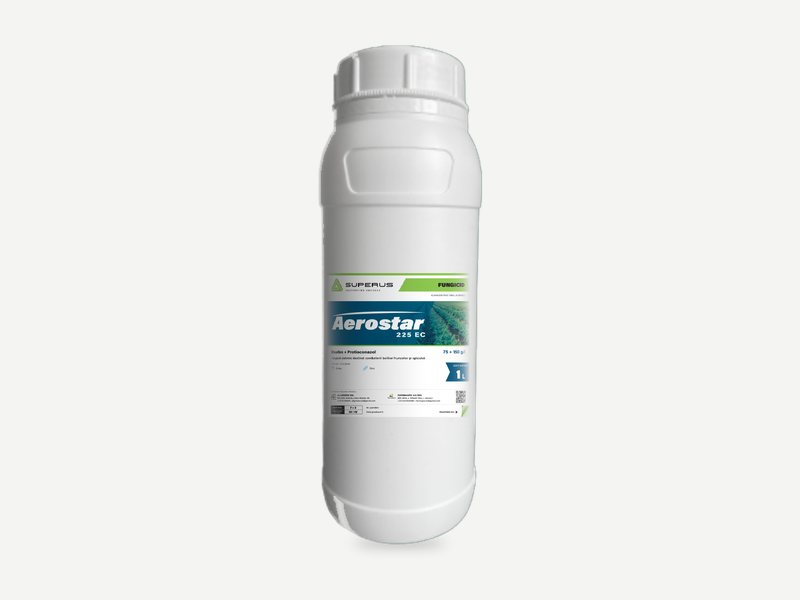

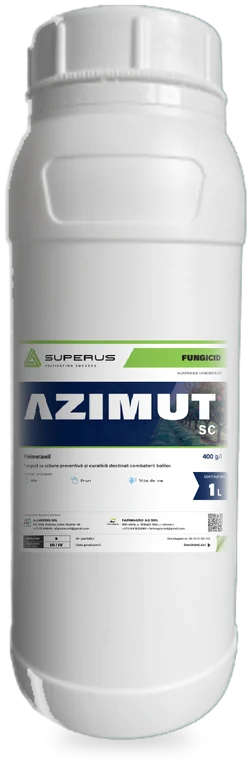
Azimut SC
Fongicide à action préventive et curative pour la lutte contre les maladies.
 Pommier
 Prunier
 Vigne
Mode d'emploi
Cultures, organismes cibles et doses. Respectez toujours l'étiquette du produit tel qu'il est homologué dans votre pays.
| Culture | Organisme cible | Dose (l/ha) | Application | DAR, jours (nb max. de traitements) | Délai de rentrée, jours manuel (mécanisé) |
|---|---|---|---|---|---|
| Pommier | Venturia inaequalis (tavelure) | 0,8-1,0 | Pulvérisation foliaire pendant la période de végétation | 21 (2-3) | 7 (3) |
| Prunier | Monilia spp. (moniliose) | 1,0-1,5 | Pulvérisation foliaire au début de la floraison (env. 5 % des fleurs ouvertes) et après la floraison (env. 75 % de chute des pétales) | 28 (2-3) | 7 (3) |
| Vigne | Pourriture grise (Botrytis cinerea) | 2,0 - 2,4 | Pulvérisation foliaire pendant la période de végétation, (BBCH 62- 81) | 21 (1) | 3 (1) |
Informations techniques
Mode d'action
Azimut SC is a fungicide with preventive and curative properties against phytopathogenic fungi. It acts by blocking the production of methionine, an amino acid essential for fungal growth and reproduction, which results in poor development of infections. Azimut SC is effective against both the vegetative and the generative forms of fungi. It is also a contact fungicide that prevents the growth and division of the affected cells.
Propriétés physico-chimiques
Azimut SC is presented as a creamy-white suspension concentrate with a specific odour, containing pyrimethanil 400 g/l; the product is not corrosive.
Compatibilité
Azimut SC is compatible with most pesticides; however, it is recommended to carry out a compatibility test beforehand for each mixture.
Technique d'application
Sprayer: use a sprayer that ensures uniform distribution of the spray solution. Application: use the required volume of spray solution to obtain complete coverage of the plant surface. Fill 1/3 of the sprayer tank with water, then add the required quantity of product and, with continuous agitation, top up the tank with the required quantity of water. Spray solution volume: 800-1000 l/ha in fruit crops.
Restrictions & limitations
Azimut SC must be used only on the registered crops and in accordance with the recommended conditions of use. Pollution of water bodies with spray solution as a result of run-off, disposal of leftover solution or washing of equipment must be prevented.
Phytotoxicité
Azimut SC has no phytotoxic effect on agricultural crops when used in accordance with the label recommendations.
Toxicité
Hazard category III/IV for acute oral toxicity, humans/bees
- Classe de toxicité (homme / abeilles)
- III / IV
Sécurité, stockage & élimination
Classification & mentions de danger
Mention d'avertissement : Attention
Mentions de danger
- H411 — Toxique pour les organismes aquatiques, entraîne des effets néfastes à long terme.
Conseils de prudence
- P101 — En cas de consultation d'un médecin, garder à disposition le récipient ou l'étiquette.
- P102 — Tenir hors de portée des enfants.
- P273 — Éviter le rejet dans l'environnement.
- P391 — Recueillir le produit répandu.
- P501 — Éliminer le contenu/récipient conformément à la réglementation locale.
Mesures de sécurité lors de l'application
Avoid contact with skin, eyes and clothing. Protective equipment and protective gloves must be worn during work. Use personal protective clothing. Keep work clothing separately. Adequate airing and ventilation of the workplace and storage area is required. Do not eat, drink or smoke when using this product. Hands and/or face must be washed before breaks and at the end of the working day. If medical advice is needed, have the product container or label at hand. Avoid breathing mist, vapours or spray. Do not take contaminated work clothing out of the workplace. After using the product, wash thoroughly any parts of the body that have been contaminated. Take off contaminated clothing and wash it before re-use. Read carefully and follow all instructions.
Premiers secours
In case of eye contact: rinse with plenty of clean water for at least 15 minutes, including under the eyelids. Remove contact lenses, if present. In case of skin contact: immediately remove contaminated clothing and wash the contaminated areas of the body with plenty of water. If irritation persists, seek medical advice. Wash contaminated clothing before re-use. If swallowed: give the casualty plenty of water to drink. Do not induce vomiting. Call a doctor immediately. If inhaled: move the casualty to fresh air. If breathing is irregular or has stopped, give artificial respiration. Seek medical attention if the casualty feels unwell. THERE IS NO ANTIDOTE; TREAT SYMPTOMATICALLY.
Stockage & transport
Store the product in its original, sealed packaging, in dry rooms intended exclusively for pesticides, separately from food, beverages, tobacco products and animal feed. Protect from direct sunlight. Protect from temperatures below 0°C or above +35°C. During handling, transport and storage, occupational safety measures must be taken and the product must be protected from extreme temperature variations.
Élimination et décontamination des emballages
Prevent any further leakage of the product, if this can be done safely. Do not discharge the product into surface waters or sewage systems. Contain the spill, then collect the accidentally spilled product by mechanical means and place it in suitable containers for subsequent disposal as hazardous waste. After removing the product, wash the spill site with water. If the product contaminates rivers, lakes or drains, inform the competent authorities. After emptying, rinse the containers three times and add the rinse water to the spray solution. Dispose of empty containers in accordance with the regulations in force. Do not re-use empty containers for any other purpose.
Inflammabilité
The product is not explosive and has no oxidising properties. It is stable under normal storage and handling conditions. Extinguishing media: water spray, alcohol-resistant foam, dry chemical extinguisher or carbon dioxide. Advice for firefighters: use self-contained breathing apparatus and wear full protective equipment, if necessary. Thermal decomposition may generate: carbon oxides, nitrogen oxides.