
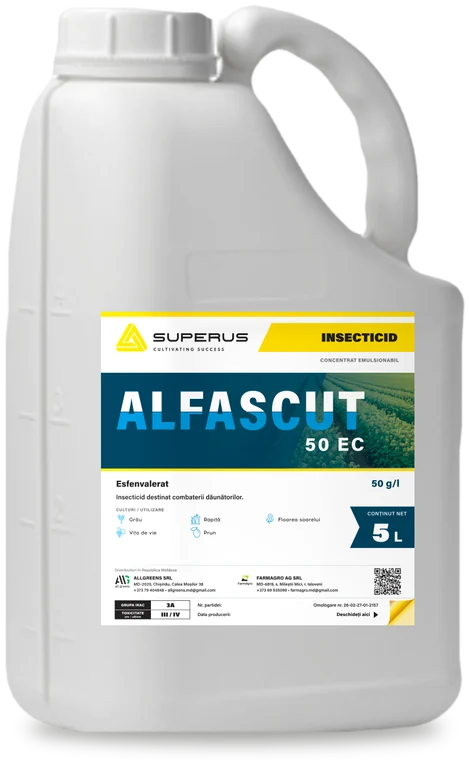
Alfascut 50 EC
Insecticide for the control of pests.
 Wheat
 Rapeseed
 Sunflower
 Grapevine
 Plum
Instructions for use
Crops, target organisms and rates. Always follow the label of the product as registered in your country.
| Crop | Target organism | Rate (l/ha) | Application | PHI, days (max. treatments) | Re-entry, days manual (mechanised) |
|---|---|---|---|---|---|
| Rapeseed | Pollen beetle, flea beetles | 0,25-0,3 | Foliar spray during the growing season | 20 / 2 | 7 (3) |
| Wheat | Cereal leaf beetle, bugs | 0,25-0,3 | Foliar spray during the growing season | 15 / 2 | 7 (3) |
| Sunflower | Aphids, bugs, beet webworm, cotton bollworm | 0,4-0,6 | Foliar spray during the growing season | 28(1-2) | 10(4) |
| Grapevine | Green grape moth | 0,4-0,6 | Foliar spray during the growing season | 45(1-2) | 10(4) |
| Plum | Plum fruit moth, plum seed wasp | 0,6-0,75 + Aqua Wet 1l/ha SAS | Foliar spray during the growing season | 30(1) | 10(4) |
Technical information
Mode of action
ALFASCUT 50 EC is an insecticide containing esfenvalerate, 50 g/l. Esfenvalerate acts as a neurotoxic insecticide by targeting the voltage-gated sodium channels in the nerve cells of insects, causing prolonged opening of these channels, continuous nerve firing and, subsequently, paralysis and death. As a synthetic pyrethroid, it disrupts the insect's nervous system, causing symptoms such as hyperactivity, convulsions, lethargy and ultimately death, which results from the insect's inability to feed.
Physical & chemical properties
ALFASCUT 50 EC is presented as a yellowish emulsifiable concentrate (emulsion in water) containing esfenvalerate, 50 g/l; the product is not corrosive.
Compatibility
ALFASCUT 50 EC is compatible with most fungicides and insecticides, but a preliminary test must be carried out to establish the compatibility of each mixture.
Application technique
Sprayer: use a sprayer that ensures uniform distribution of the spray solution. Application of treatments: use the required volume of spray solution to obtain complete coverage of the plant surface. Spray solution volume: 300-400 l/ha.
Restrictions & limitations
ALFASCUT 50 EC must be used only on the registered crops and in accordance with the recommended conditions of use. Pollution of water bodies with spray solution as a result of run-off, disposal of leftover solution or washing of equipment must be prevented. Re-entry interval for mechanised work: 3 days; for manual work: 7 days.
Phytotoxicity
At the recommended doses, ALFASCUT 50 EC has no phytotoxic effect on agricultural crops.
Toxicity
Toxicity class III. Oral LD50 (rats): 55 mg/kg. Dermal LD50: 2000 mg/kg. Non-irritant to the skin. Slightly irritant to the eye mucosa.
- Toxicity class (human / bees)
- III / IV
- LD50 oral (rat)
- 55 mg/kg
- LD50 dermal
- 2000 mg/kg
Safety, storage & disposal
Classification & hazard statements
Signal word: Warning
Hazard statements
- H317 — May cause an allergic skin reaction.
- H361d — Suspected of damaging the unborn child.
- H410 — Very toxic to aquatic life with long lasting effects.
Precautionary statements
- P261 — Avoid breathing dust, fume, gas, mist, vapours or spray.
- P272 — Contaminated work clothing should not be allowed out of the workplace.
- P273 — Avoid release to the environment.
- P280 — Wear protective gloves, protective clothing, eye protection and face protection.
- P302+P352 — IF ON SKIN: Wash with plenty of water and soap.
- P308+P313 — IF exposed or concerned: Get medical advice/attention.
- P333+P313 — If skin irritation or rash occurs: Get medical advice/attention.
- P362+P364 — Take off contaminated clothing and wash it before reuse.
- P391 — Collect spillage.
- P405 — Store locked up.
- P501 — Dispose of contents/container in accordance with local regulations.
Safety measures during application
Keep out of the reach of children! Observe occupational safety and hygiene measures! Avoid inhaling the spray solution as dust or aerosol. Do not drink, eat or smoke while working with the product. When preparing the spray solution and during spraying, protective equipment must be worn (universal safety goggles, special clothing and footwear, gloves, respiratory protective equipment). After work, wash hands and exposed parts of the body thoroughly with soap and water.
First aid
In case of poisoning by ingestion, skin contact or inhalation, take the following measures: - Remove the casualty from the toxic or contaminated environment; - Remove contaminated clothing; - Wash the skin with plenty of soap and water; - Rinse the eyes, including under the eyelids, with water for at least 15 minutes; - If swallowed, rinse the mouth with water, do NOT induce vomiting; - Transport the casualty urgently to the nearest medical facility; - Symptomatic treatment under medical supervision. THERE ARE NO KNOWN ANTIDOTES.
Storage & transport
Store the product in its original, undamaged, labelled packaging, in locked, dry, cool, well-ventilated rooms, protected from direct heat and sunlight, out of the reach of children and separately from food and animal feed. Transport away from heat. During handling, transport and storage, all occupational safety and hygiene measures must be observed. Emptied containers must not be used for any other purpose.
Packaging disposal & decontamination
Re-use of emptied containers is prohibited! Emptied containers must not be discarded or used for any other purpose; emptied containers must be destroyed at special sites designated for this purpose. Contamination of water reservoirs and other water sources with residues of the product or with emptied containers is prohibited. If the product is spilled on the soil surface, prevent it from running off into sewage systems or water reservoirs. Contaminated soil should be covered with sand or earth, then collected and buried at special sites designated for this purpose.
Flammability
NON-FLAMMABLE PRODUCT. In case of fire, use the following extinguishing media: water, foam, dry chemicals.
Sprayer cleaning
After finishing work, wash the sprayer equipment thoroughly with clean water. Use the rinse water for spraying the crop.