
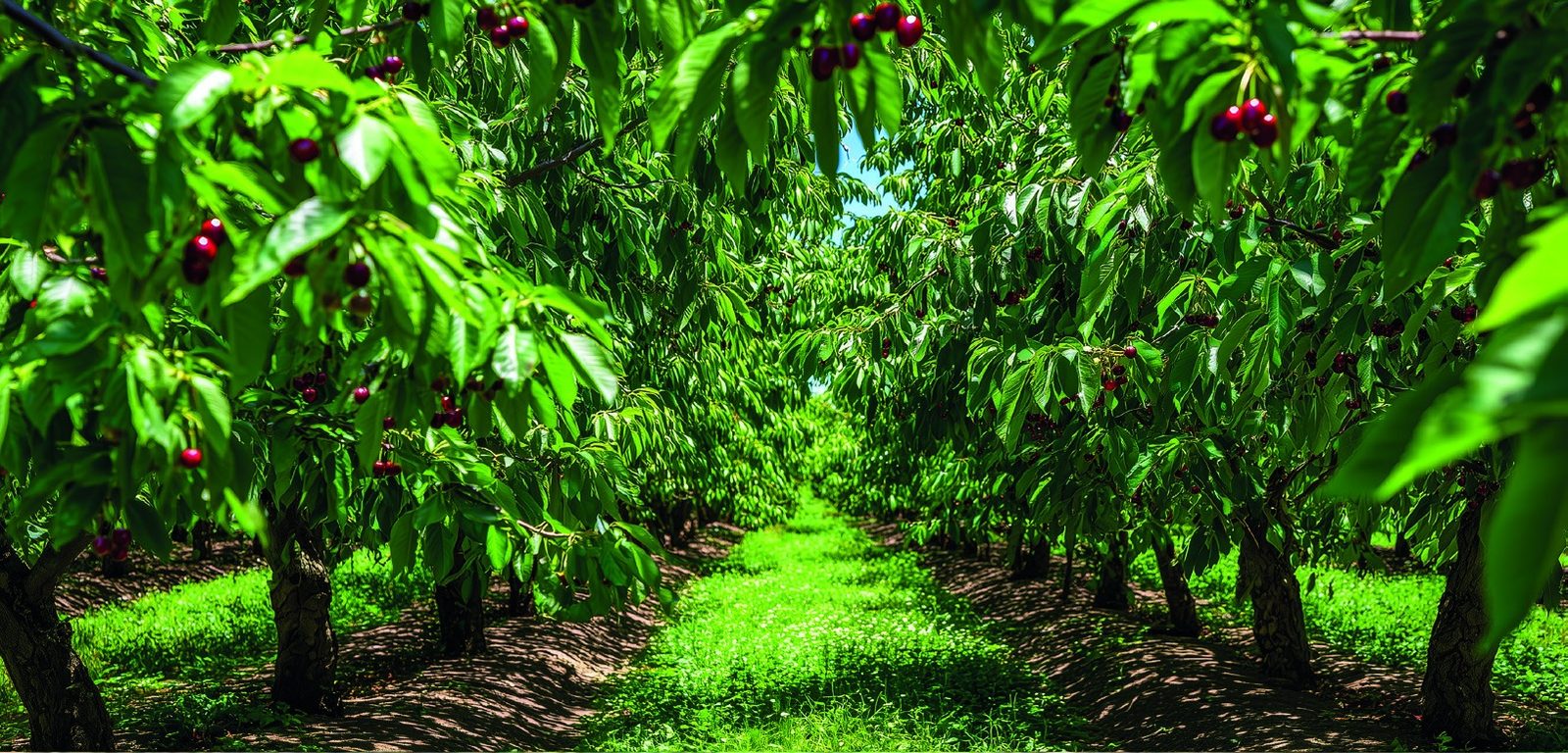
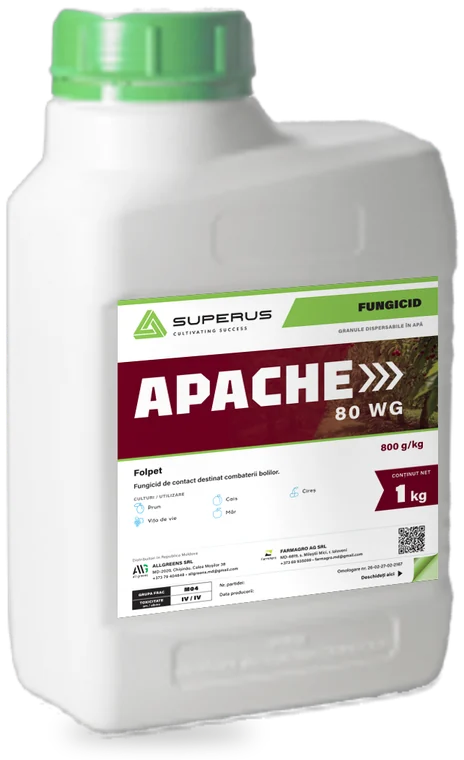
Apache 80 WG
Contact fungicide for the control of diseases.
 Plum
 Apricot
 Cherry
 Grapevine
 Apple
Instructions for use
Crops, target organisms and rates. Always follow the label of the product as registered in your country.
| Crop | Target organism | Rate (kg/ha) | Application | PHI, days (max. treatments) | Re-entry, days manual (mechanised) |
|---|---|---|---|---|---|
| Plum | Shot-hole disease (clasterosporium carpophilum) | 2,0-2,5 | Foliar spray during the flowering period | 21 (2) | 7 (3) |
| Apricot | Shot-hole disease (clasterosporium carpophilum) | 2,0-2,5 | Foliar spray during the flowering period | 21 (2) | 7 (3) |
| Cherry | Shot-hole disease (clasterosporium carpophilum) | 2,0-2,5 | Foliar spray during the flowering period | 21 (2) | 7 (3) |
| Grapevine | Downy mildew (Plasmopara viticola) | 2,0-2,5 | Foliar spray during the flowering period | 21 (2) | 7 (3) |
| Apple | Scab | 2,0 | Foliar spray during the flowering period | 40 (2-3) | 7 (3) |
Technical information
Mode of action
Apache 80 WG is a multi-site contact fungicide that acts by binding to the thiol groups of fungal proteins and enzymes, disrupting metabolism and cellular respiration, which leads to the death of the pathogen. It is effective as a preventive treatment and has a broad spectrum of control.
Physical & chemical properties
Apache 80 WG is a multi-site fungicide, stable in its packaging, with low water solubility and rapid photodegradation. The WG formulation makes it easy to handle and apply, and it is effective against a broad spectrum of foliar and fruit fungi. It is recommended to follow the storage and application instructions in order to maximise efficacy and safety of use.
Compatibility
Apache 80 WG has very good compatibility with most fungicides, insecticides and foliar fertilisers. The only limitations: avoid very alkaline solutions and carry out a mixing test before practical application. It can be used both in tank mixtures and in rotation with other modes of action, providing effective and sustainable crop protection.
Application technique
Sprayer: use a sprayer that ensures uniform distribution of the spray solution. Application of treatments: use the required volume of spray solution to obtain complete coverage of the plant surface. Spray solution volume: 800-1000 l/ha.
Restrictions & limitations
Apache 80 WG must be used only on the registered crops and in accordance with the recommended conditions of use. Pollution of water bodies with spray solution as a result of run-off, disposal of leftover solution or washing of equipment must be prevented. Re-entry interval for mechanised work: 3 days; for manual work: 7 days.
Phytotoxicity
At the recommended doses, Apache 80 WG has no phytotoxic effect on agricultural crops.
Toxicity
Toxicity class IV. Oral LD50 (rats): >2000 mg/kg. Dermal LD50: >2000 mg/kg. Non-irritant to the skin. Irritant to the eye mucosa.
- Toxicity class (human / bees)
- IV / IV
- LD50 oral (rat)
- >2000 mg/kg
- LD50 dermal
- >2000 mg/kg
Safety, storage & disposal
Classification & hazard statements
Signal word: Danger
Hazard statements
- H317 — May cause an allergic skin reaction.
- H318 — Causes serious eye damage.
- H351 — Suspected of causing cancer.
- H372 — Causes damage to organs through prolonged or repeated exposure.
- H410 — Very toxic to aquatic life with long lasting effects.
- EUH401 — To avoid risks to human health and the environment, comply with the instructions for use.
Precautionary statements
- P102 — Keep out of reach of children.
- P260 — Do not breathe dust, fume, gas, mist, vapours or spray.
- P270 — Do not eat, drink or smoke when using this product.
- P280 — Wear protective gloves, protective clothing, eye protection and face protection.
- P305+P351+P338 — IF IN EYES: Rinse cautiously with water for several minutes. Remove contact lenses, if present and easy to do. Continue rinsing.
- P308+P313 — IF exposed or concerned: Get medical advice/attention.
- P310 — Immediately call a POISON CENTER or doctor.
- P314 — Get medical advice/attention if you feel unwell.
- P333+P313 — If skin irritation or rash occurs: Get medical advice/attention.
- P391 — Collect spillage.
- P501 — Dispose of contents/container in accordance with local regulations.
Safety measures during application
Keep out of the reach of children! Observe occupational safety and hygiene measures! Avoid inhaling the spray solution as dust or aerosol. Do not drink, eat or smoke while working with the product. When preparing the spray solution and during spraying, protective equipment must be worn (universal safety goggles, special clothing and footwear, gloves, respiratory protective equipment). After work, wash hands and exposed parts of the body thoroughly with soap and water.
First aid
-Remove the casualty from the toxic or contaminated environment; -Remove contaminated clothing; -Wash the skin with plenty of soap and water; -Rinse the eyes, including under the eyelids, with water for at least 15 minutes; -If swallowed, rinse the mouth with water, do NOT induce vomiting; -Transport the casualty urgently to the nearest medical facility; -Symptomatic treatment under medical supervision. THERE ARE NO KNOWN ANTIDOTES.
Storage & transport
Store the product in its original, undamaged, labelled packaging, in locked, dry, cool, well-ventilated rooms, protected from direct heat and sunlight, out of the reach of children and separately from food and animal feed. Transport away from heat. During handling, transport and storage, all occupational safety and hygiene measures must be observed. Emptied containers must not be used for any other purpose.
Packaging disposal & decontamination
Re-use of emptied containers is prohibited! Emptied containers must not be discarded or used for any other purpose; emptied containers must be destroyed at special sites designated for this purpose. Contamination of water reservoirs and other water sources with residues of the product or with emptied containers is prohibited. If the product is spilled on the soil surface, prevent it from running off into sewage systems or water reservoirs. Contaminated soil should be covered with sand or earth, then collected and buried at special sites designated for this purpose.
Flammability
NON-FLAMMABLE PRODUCT. In case of fire, use the following extinguishing media: water, foam, dry chemicals.
More fungicides
 Fungicide
Aerostar 225 EC
 Fungicide
Antaris 200 SC
 Fungicide