
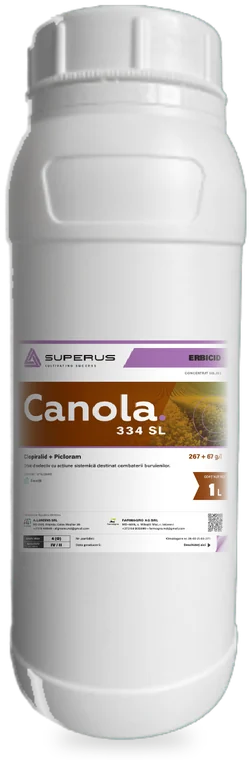
Canola 334 SL
Selective systemic herbicide for the control of weeds (field bindweed, orache species, cleavers, sow-thistle, redroot pigweed, Venice mallow, creeping thistle species, black bindweed, mayweed, common fumitory).
 Rapeseed
Instructions for use
Crops, target organisms and rates. Always follow the label of the product as registered in your country.
| Crop | Target organism | Rate (l/ha) | Application | PHI, days (max. treatments) | Re-entry, days manual (mechanised) |
|---|---|---|---|---|---|
| Rapeseed | Annual and perennial broad-leaved weeds, including cleavers and common poppy | 0,3-0,35 | Spray the crop in autumn or spring, before the appearance of flower buds (8–10 leaves of rapeseed) | - (1) | 7 (3) |
Technical information
Mode of action
CANOLA 334 SL is a selective combination herbicide based on clopyralid, 267 g/l + picloram, 67 g/l. Clopyralid acts as a synthetic auxin-type herbicide, absorbed through the leaves and roots and translocated throughout the plant to the growing points. Once there, it replaces and blocks the plant's natural growth hormones, causing a hormonal imbalance that leads to the disruption of cell division and growth, ultimately resulting in the death of susceptible weeds. Picloram acts as a systemic herbicide, penetrating through the leaves and roots of plants and mimicking the natural auxins, which leads to uncontrolled growth and blocks normal growth processes. As a result, the plants stop growing, the cells neither divide nor elongate, and then twist, become deformed and die, leading to the death of the weeds.
Physical & chemical properties
CANOLA 334 SL is presented as a yellowish water-soluble concentrate containing clopyralid, 267 g/l + picloram, 67 g/l; the product is not corrosive.
Compatibility
CANOLA 334 SL is compatible with most fungicides and insecticides, but a preliminary test must be carried out to establish the compatibility of each mixture.
Application technique
Sprayer: use a sprayer that ensures uniform distribution of the spray solution. Application of treatments: use the required volume of spray solution to obtain complete coverage of the plant surface. Spray solution volume: 250-300 l/ha.
Restrictions & limitations
CANOLA 334 SL must be used only on the registered crops and in accordance with the recommended conditions of use. Pollution of water bodies with spray solution as a result of run-off, disposal of leftover solution or washing of equipment must be prevented. Re-entry interval for mechanised work: 3 days; for manual work: 7 days.
Phytotoxicity
At the recommended doses, CANOLA 334 SL has no phytotoxic effect on agricultural crops.
Toxicity
Toxicity class IV. Oral LD50 (rats): 5000 mg/kg. Dermal LD50: 2500 mg/kg. Non-irritant to the skin. Slightly irritant to the eye mucosa.
- Toxicity class (human / bees)
- IV / II
- LD50 oral (rat)
- 5000 mg/kg
- LD50 dermal
- 2500 mg/kg
Safety, storage & disposal
Classification & hazard statements
Signal word: Danger
Hazard statements
- H318 — Causes serious eye damage.
- H361d — Suspected of damaging the unborn child.
- H410 — Very toxic to aquatic life with long lasting effects.
Precautionary statements
- P273 — Avoid release to the environment.
- P280 — Wear protective gloves, protective clothing, eye protection and face protection.
- P305+P351+P338 — IF IN EYES: Rinse cautiously with water for several minutes. Remove contact lenses, if present and easy to do. Continue rinsing.
- P308+P313 — IF exposed or concerned: Get medical advice/attention.
- P310 — Immediately call a POISON CENTER or doctor.
- P391 — Collect spillage.
- P405 — Store locked up.
- P501 — Dispose of contents/container in accordance with local regulations.
Safety measures during application
Keep out of the reach of children! Observe occupational safety and hygiene measures! Avoid inhaling the spray solution as dust or aerosol. Do not drink, eat or smoke while working with the product. When preparing the spray solution and during spraying, protective equipment must be worn (universal safety goggles, special clothing and footwear, gloves, respiratory protective equipment). After work, wash hands and exposed parts of the body thoroughly with soap and water.
First aid
In case of poisoning by ingestion, skin contact or inhalation, take the following measures: - Remove the casualty from the toxic or contaminated environment; - Remove contaminated clothing; - Wash the skin with plenty of soap and water; - Rinse the eyes, including under the eyelids, with water for at least 15 minutes; - If swallowed, rinse the mouth with water, do NOT induce vomiting; - Transport the casualty urgently to the nearest medical facility; - Symptomatic treatment under medical supervision. THERE ARE NO KNOWN ANTIDOTES.
Storage & transport
Store the product in its original, undamaged, labelled packaging, in locked, dry, cool, well-ventilated rooms, protected from direct heat and sunlight, out of the reach of children and separately from food and animal feed. Transport away from heat. During handling, transport and storage, all occupational safety and hygiene measures must be observed. Emptied containers must not be used for any other purpose.
Packaging disposal & decontamination
Re-use of emptied containers is prohibited! Emptied containers must not be discarded or used for any other purpose; emptied containers must be destroyed at special sites designated for this purpose. Contamination of water reservoirs and other water sources with residues of the product or with emptied containers is prohibited. If the product is spilled on the soil surface, prevent it from running off into sewage systems or water reservoirs. Contaminated soil should be covered with sand or earth, then collected and buried at special sites designated for this purpose.
Flammability
NON-FLAMMABLE PRODUCT. In case of fire, use the following extinguishing media: water, foam, dry chemicals.