
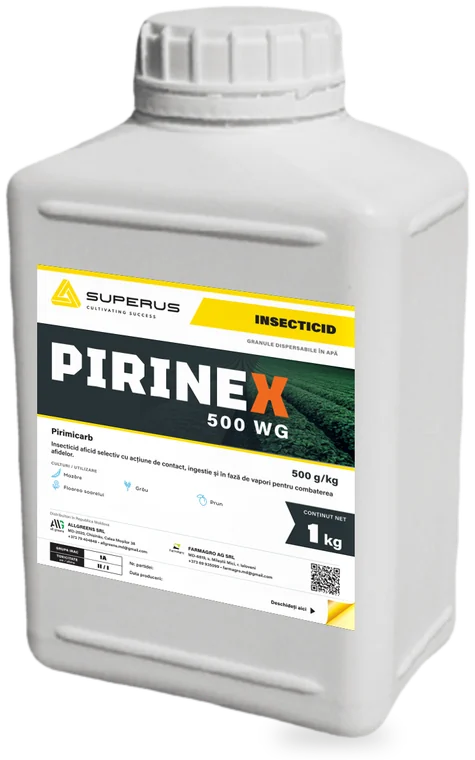
Pirinex 500 WG
Selektives Blattlausinsektizid mit Kontakt-, Fraß- und Dampfwirkung zur Bekämpfung von Blattläusen.
 Erbse
 Weizen
 Pflaume
 Sonnenblume
Anwendungshinweise
Kulturen, Zielorganismen und Aufwandmengen. Beachten Sie stets das Etikett des in Ihrem Land zugelassenen Produkts.
| Kultur | Zielorganismus | Aufwandmenge (kg/ha) | Anwendung | Wartezeit, Tage (max. Anwendungen) | Wiederbetreten, Tage manuell (mechanisiert) |
|---|---|---|---|---|---|
| Erbse | Grüne Erbsenblattlaus | 0,5 + 0,1 Novawet 408 | Blattspritzung während der Vegetationsperiode | 7(1) | 7 (3) |
| Weizen | Blattläuse | 0,25 + 0,1 Novawet 408 | Blattspritzung während der Vegetationsperiode | 35(1) | 7 (3) |
| Pflaume | Mehlige Pflaumenblattlaus | 0,45-0,5 + 0,1 Novawet 408 | Blattspritzung während der Vegetationsperiode | 7(1) | 7 (3) |
| Sonnenblume | Grüne Sonnenblumenblattlaus | 0,35-0,5 + 0,1 Novawet 408 | Blattspritzung während der Vegetationsperiode | 21(1) | 7 (3) |
Technische Informationen
Wirkungsweise
Pirinex 500 WG is a selective aphicidal insecticide from the carbamate group, with contact, stomach and vapour-phase action. Pirimicarb inhibits acetylcholinesterase in the nervous system of aphids, causing paralysis and rapid death. It has systemic and translaminar action, reaches the colonies in curled leaves and also controls aphids resistant to organophosphates. It works best above 15 °C and largely spares beneficial insects.
Physikalisch-chemische Eigenschaften
Pirinex 500 WG is presented as bluish-green to green water-dispersible granules, which form a stable suspension in water; it contains pirimicarb, 500 g/kg.
Mischbarkeit
Pirinex 500 WG is compatible with most fungicides and insecticides and with the adjuvant Novawett 408 SAS (see the table); a compatibility test is required. Do not mix with strongly alkaline products.
Anwendungstechnik
Use a sprayer that ensures uniform distribution of the solution. The granules are added first to the tank, partly filled with water, with the agitator running; the adjuvant is added last. Spray volume – 200-400 l/ha in pea, wheat and sunflower; 800-1000 l/ha in plum. Apply when colonies appear.
Einschränkungen & Auflagen
Use only on the registered crops. Pollution of water bodies must be avoided. One treatment per season. Do not apply to flowering crops or weeds, or where bees are foraging; beekeepers must be warned. Hazard category II (Law 119/2004, art. 17): sale only with a training certificate, no application from aircraft. Re-entry: mechanised work – 3 days, manual work – 7 days.
Phytotoxizität
At the recommended doses, Pirinex 500 WG has no phytotoxic effect on agricultural crops.
Toxizität
Acute oral toxicity hazard category, human/bees: II / I
- Toxizitätsklasse (Mensch / Bienen)
- II / I
Sicherheit, Lagerung & Entsorgung
Einstufung & Gefahrenhinweise
Signalwort: Gefahr
Gefahrenhinweise
- H301 — Giftig bei Verschlucken.
- H317 — Kann allergische Hautreaktionen verursachen.
- H319 — Verursacht schwere Augenreizung.
- H332 — Gesundheitsschädlich bei Einatmen.
- H351 — Kann vermutlich Krebs erzeugen.
- H410 — Sehr giftig für Wasserorganismen mit langfristiger Wirkung.
- EUH208 — Enthält einen sensibilisierenden Stoff. Kann allergische Reaktionen hervorrufen.
- EUH401 — Zur Vermeidung von Risiken für Mensch und Umwelt die Gebrauchsanleitung einhalten.
Sicherheitshinweise
- P261 — Einatmen von Staub/Rauch/Gas/Nebel/Dampf/Aerosol vermeiden.
- P272 — Kontaminierte Arbeitskleidung nicht außerhalb des Arbeitsplatzes tragen.
- P280 — Schutzhandschuhe, Schutzkleidung, Augenschutz und Gesichtsschutz tragen.
- P301+P312 — BEI VERSCHLUCKEN: Bei Unwohlsein GIFTINFORMATIONSZENTRUM oder Arzt anrufen.
- P302+P352 — BEI BERÜHRUNG MIT DER HAUT: Mit viel Wasser und Seife waschen.
- P305+P351+P338 — BEI KONTAKT MIT DEN AUGEN: Einige Minuten lang behutsam mit Wasser ausspülen. Eventuell vorhandene Kontaktlinsen nach Möglichkeit entfernen. Weiter ausspülen.
- P333+P313 — Bei Hautreizung oder -ausschlag: Ärztlichen Rat einholen/ärztliche Hilfe hinzuziehen.
- P362+P364 — Kontaminierte Kleidung ausziehen und vor erneutem Tragen waschen.
- P391 — Verschüttete Mengen aufnehmen.
- P501 — Inhalt/Behälter gemäß den örtlichen Vorschriften der Entsorgung zuführen.
Sicherheitsmaßnahmen bei der Anwendung
Avoid contact with skin, eyes and clothing. Protective equipment and protective gloves must be worn during work. Use personal protective clothing. Keep work clothing separate. Adequate airing and ventilation of the workplace and storage area is required. Do not eat, drink or smoke when using this product. Hands and/or face must be washed before breaks and at the end of the working day. If medical advice is needed, have the product container or label at hand. Avoid breathing mist, vapours or spray. Do not take contaminated work clothing out of the workplace. After using the product, wash thoroughly any parts of the body that have been contaminated. Take off contaminated clothing and wash it before re-use. Read carefully and follow all instructions. Trained persons only; avoid dust; wear gloves, goggles, clothing and a dust mask. If symptoms of poisoning occur, stop work and call a doctor.
Erste Hilfe
In case of contact with eyes – rinse with plenty of clean water for at least 15 minutes, including under the eyelids. Remove contact lenses, if present. In case of contact with skin – remove contaminated clothing immediately and wash the contaminated areas of the body with plenty of water. If irritation persists, call a doctor. Wash contaminated clothing before re-use. If swallowed – give the victim plenty of water to drink. Do not induce vomiting. Notify a doctor immediately. If inhaled – move the victim to fresh air. If breathing is irregular or has stopped, give artificial respiration. Seek medical attention if the victim feels unwell. Cholinesterase inhibitor. The casualty – at rest, kept warm, hospitalised for at least 24 hours; in case of breathing disorders – artificial respiration. For the doctor: convulsions – diazepam 10 mg i.v.; no opiates or barbiturates. ANTIDOTE: ATROPINE SULPHATE, administered as quickly as possible, only by qualified medical personnel – 2-5 mg intramuscularly every 20 minutes (in children in divided doses), until full atropinisation. Atropine is not given to a cyanotic patient – oxygen is given first.
Lagerung & Transport
Store the product in its original, sealed packaging, in dry rooms intended exclusively for pesticides, separately from food, beverages, tobacco products and animal feed. Protect from direct sunlight. Protect from temperatures below 0°C or above +35°C. During handling, transport and storage, occupational safety measures must be taken and the product must be protected from extreme temperature variations.
Entsorgung & Dekontamination der Verpackung
Prevent any possibility of product leakage, if this can be done safely. Do not discharge the product into surface waters or sewer systems. Contain the spill, then collect the accidentally spilled product by mechanical means and place it in suitable containers for subsequent disposal as hazardous waste. After removing the product, wash the spill site with water. If the product contaminates rivers, lakes or drains, inform the competent authorities. After emptying, rinse the containers three times and add the rinse water to the spray solution. Dispose of empty containers in accordance with the regulations in force. Do not re-use empty containers for any other purpose.
Entflammbarkeit
NON-FLAMMABLE PRODUCT. The fine dust of the product may form explosive mixtures with air: avoid the formation of dust, ignition sources and electrostatic discharges during handling. In case of fire, use the following extinguishing media: water spray, foam, dry chemical powders, carbon dioxide; on burning, toxic and irritant vapours are released – use self-contained breathing apparatus.