
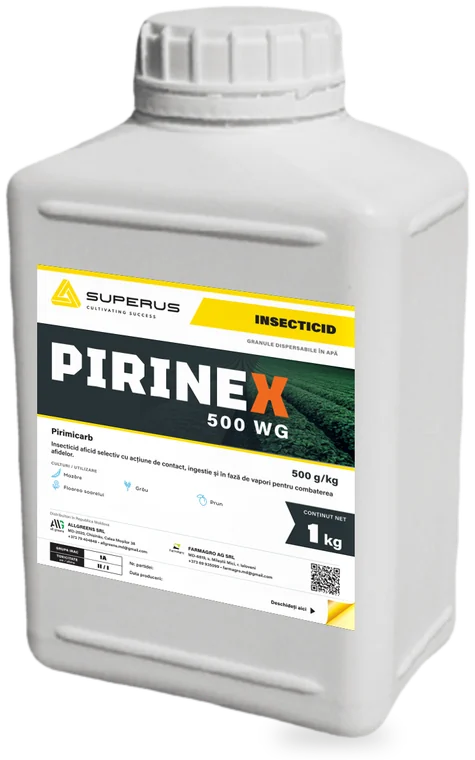
Pirinex 500 WG
Insecticide aphicide sélectif à action de contact, d'ingestion et en phase vapeur pour la lutte contre les pucerons.
 Pois
 Blé
 Prunier
 Tournesol
Mode d'emploi
Cultures, organismes cibles et doses. Respectez toujours l'étiquette du produit tel qu'il est homologué dans votre pays.
| Culture | Organisme cible | Dose (kg/ha) | Application | DAR, jours (nb max. de traitements) | Délai de rentrée, jours manuel (mécanisé) |
|---|---|---|---|---|---|
| Pois | Puceron vert du pois | 0,5 + 0,1 Novawet 408 | Pulvérisation foliaire pendant la période de végétation | 7(1) | 7 (3) |
| Blé | Pucerons | 0,25 + 0,1 Novawet 408 | Pulvérisation foliaire pendant la période de végétation | 35(1) | 7 (3) |
| Prunier | Puceron farineux du prunier | 0,45-0,5 + 0,1 Novawet 408 | Pulvérisation foliaire pendant la période de végétation | 7(1) | 7 (3) |
| Tournesol | Puceron vert du tournesol | 0,35-0,5 + 0,1 Novawet 408 | Pulvérisation foliaire pendant la période de végétation | 21(1) | 7 (3) |
Informations techniques
Mode d'action
Pirinex 500 WG is a selective aphicidal insecticide from the carbamate group, with contact, stomach and vapour-phase action. Pirimicarb inhibits acetylcholinesterase in the nervous system of aphids, causing paralysis and rapid death. It has systemic and translaminar action, reaches the colonies in curled leaves and also controls aphids resistant to organophosphates. It works best above 15 °C and largely spares beneficial insects.
Propriétés physico-chimiques
Pirinex 500 WG is presented as bluish-green to green water-dispersible granules, which form a stable suspension in water; it contains pirimicarb, 500 g/kg.
Compatibilité
Pirinex 500 WG is compatible with most fungicides and insecticides and with the adjuvant Novawett 408 SAS (see the table); a compatibility test is required. Do not mix with strongly alkaline products.
Technique d'application
Use a sprayer that ensures uniform distribution of the solution. The granules are added first to the tank, partly filled with water, with the agitator running; the adjuvant is added last. Spray volume – 200-400 l/ha in pea, wheat and sunflower; 800-1000 l/ha in plum. Apply when colonies appear.
Restrictions & limitations
Use only on the registered crops. Pollution of water bodies must be avoided. One treatment per season. Do not apply to flowering crops or weeds, or where bees are foraging; beekeepers must be warned. Hazard category II (Law 119/2004, art. 17): sale only with a training certificate, no application from aircraft. Re-entry: mechanised work – 3 days, manual work – 7 days.
Phytotoxicité
At the recommended doses, Pirinex 500 WG has no phytotoxic effect on agricultural crops.
Toxicité
Acute oral toxicity hazard category, human/bees: II / I
- Classe de toxicité (homme / abeilles)
- II / I
Sécurité, stockage & élimination
Classification & mentions de danger
Mention d'avertissement : Danger
Mentions de danger
- H301 — Toxique en cas d'ingestion.
- H317 — Peut provoquer une allergie cutanée.
- H319 — Provoque une sévère irritation des yeux.
- H332 — Nocif par inhalation.
- H351 — Susceptible de provoquer le cancer.
- H410 — Très toxique pour les organismes aquatiques, entraîne des effets néfastes à long terme.
- EUH208 — Contient une substance sensibilisante. Peut produire une réaction allergique.
- EUH401 — Respectez les instructions d'utilisation pour éviter les risques pour la santé humaine et l'environnement.
Conseils de prudence
- P261 — Éviter de respirer les poussières, fumées, gaz, brouillards, vapeurs, aérosols.
- P272 — Les vêtements de travail contaminés ne devraient pas sortir du lieu de travail.
- P280 — Porter des gants de protection, des vêtements de protection, un équipement de protection des yeux et un équipement de protection du visage.
- P301+P312 — EN CAS D'INGESTION: Appeler un CENTRE ANTIPOISON ou un médecin en cas de malaise.
- P302+P352 — EN CAS DE CONTACT AVEC LA PEAU: Laver abondamment à l'eau et au savon.
- P305+P351+P338 — EN CAS DE CONTACT AVEC LES YEUX: Rincer avec précaution à l'eau pendant plusieurs minutes. Enlever les lentilles de contact si la victime en porte et si elles peuvent être facilement enlevées. Continuer à rincer.
- P333+P313 — En cas d'irritation ou d'éruption cutanée: Consulter un médecin.
- P362+P364 — Enlever les vêtements contaminés et les laver avant réutilisation.
- P391 — Recueillir le produit répandu.
- P501 — Éliminer le contenu/récipient conformément à la réglementation locale.
Mesures de sécurité lors de l'application
Avoid contact with skin, eyes and clothing. Protective equipment and protective gloves must be worn during work. Use personal protective clothing. Keep work clothing separate. Adequate airing and ventilation of the workplace and storage area is required. Do not eat, drink or smoke when using this product. Hands and/or face must be washed before breaks and at the end of the working day. If medical advice is needed, have the product container or label at hand. Avoid breathing mist, vapours or spray. Do not take contaminated work clothing out of the workplace. After using the product, wash thoroughly any parts of the body that have been contaminated. Take off contaminated clothing and wash it before re-use. Read carefully and follow all instructions. Trained persons only; avoid dust; wear gloves, goggles, clothing and a dust mask. If symptoms of poisoning occur, stop work and call a doctor.
Premiers secours
In case of contact with eyes – rinse with plenty of clean water for at least 15 minutes, including under the eyelids. Remove contact lenses, if present. In case of contact with skin – remove contaminated clothing immediately and wash the contaminated areas of the body with plenty of water. If irritation persists, call a doctor. Wash contaminated clothing before re-use. If swallowed – give the victim plenty of water to drink. Do not induce vomiting. Notify a doctor immediately. If inhaled – move the victim to fresh air. If breathing is irregular or has stopped, give artificial respiration. Seek medical attention if the victim feels unwell. Cholinesterase inhibitor. The casualty – at rest, kept warm, hospitalised for at least 24 hours; in case of breathing disorders – artificial respiration. For the doctor: convulsions – diazepam 10 mg i.v.; no opiates or barbiturates. ANTIDOTE: ATROPINE SULPHATE, administered as quickly as possible, only by qualified medical personnel – 2-5 mg intramuscularly every 20 minutes (in children in divided doses), until full atropinisation. Atropine is not given to a cyanotic patient – oxygen is given first.
Stockage & transport
Store the product in its original, sealed packaging, in dry rooms intended exclusively for pesticides, separately from food, beverages, tobacco products and animal feed. Protect from direct sunlight. Protect from temperatures below 0°C or above +35°C. During handling, transport and storage, occupational safety measures must be taken and the product must be protected from extreme temperature variations.
Élimination et décontamination des emballages
Prevent any possibility of product leakage, if this can be done safely. Do not discharge the product into surface waters or sewer systems. Contain the spill, then collect the accidentally spilled product by mechanical means and place it in suitable containers for subsequent disposal as hazardous waste. After removing the product, wash the spill site with water. If the product contaminates rivers, lakes or drains, inform the competent authorities. After emptying, rinse the containers three times and add the rinse water to the spray solution. Dispose of empty containers in accordance with the regulations in force. Do not re-use empty containers for any other purpose.
Inflammabilité
NON-FLAMMABLE PRODUCT. The fine dust of the product may form explosive mixtures with air: avoid the formation of dust, ignition sources and electrostatic discharges during handling. In case of fire, use the following extinguishing media: water spray, foam, dry chemical powders, carbon dioxide; on burning, toxic and irritant vapours are released – use self-contained breathing apparatus.