
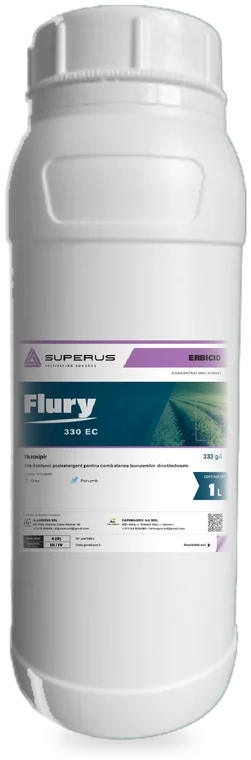
Flury 330 EC
Herbicida sistémico de posemergencia para el control de malas hierbas de hoja ancha.
 Trigo
 Maíz
Instrucciones de uso
Cultivos, organismos diana y dosis. Siga siempre la etiqueta del producto tal como está registrado en su país.
| Cultivo | Organismo diana | Dosis (l/ha) | Aplicación | Plazo de seguridad, días (n.º máx. de tratamientos) | Reentrada, días manual (mecanizado) |
|---|---|---|---|---|---|
| Trigo | Malas hierbas de hoja ancha anuales y perennes | 0,4-0,5 | Pulverizar el cultivo en el estado de ahijado | - (1) | 7 (3) |
| Maíz | Malas hierbas de hoja ancha anuales y perennes | 0,4-0,5 | Pulverización en posemergencia (estado de desarrollo del cultivo: 2-5 hojas. Estado de desarrollo de las malas hierbas: 2-4 hojas) | - (1) | 7 (3) |
Información técnica
Modo de acción
Flury 330 EC is a selective, systemic, post-emergence herbicide containing fluroxypyr (pyridine carboxylic acids, synthetic auxin, HRAC 4). It is rapidly absorbed through the leaves and reaches the growing points. It causes uncontrolled growth of the tissues: leaves and stems twist, growth stops and the weeds die within 2-3 weeks. Very effective against cleavers, field bindweed and black bindweed; rain one hour after treatment does not reduce efficacy.
Propiedades físico-químicas
Flury 330 EC is presented as a yellow emulsifiable concentrate (EC), containing fluroxypyr, 333 g/l (as fluroxypyr-meptyl, 480 g/l); the product is not corrosive.
Compatibilidad
Flury 330 EC is compatible with most pesticides, but a compatibility test is recommended for each mixture. In wheat it can be combined with sulfonylurea herbicides to widen the spectrum.
Técnica de aplicación
Sprayer: use a sprayer that ensures uniform distribution of the spray solution. Best efficacy – on young, actively growing weeds, above 10 °C. Fill 1/3 of the tank with water, add the product and, under continuous agitation, top up with water. Spray volume 200-300 l/ha.
Restricciones y limitaciones
Flury 330 EC must be used only on the registered crops. Pollution of water bodies must be avoided. In maize, do not apply if night temperatures fall below 6 °C. Replacement crops after: 5 weeks – cereals, maize, rapeseed; 10 weeks – sunflower, beet, potato, soybean, alfalfa; 15 weeks – pea, broad bean, clover. One treatment per season. Re-entry period: mechanised – 3 days, manual – 7 days.
Fitotoxicidad
In maize – temporary slowing of growth. Very sensitive to drift: grapevine, hops, sunflower, beet, potato, legumes, vegetables.
Toxicidad
Acute oral toxicity hazard category, human/bees: III / IV
- Clase de toxicidad (personas / abejas)
- III / IV
Seguridad, almacenamiento y eliminación
Clasificación e indicaciones de peligro
Palabra de advertencia: Atención
Indicaciones de peligro
- H317 — Puede provocar una reacción alérgica en la piel.
- H319 — Provoca irritación ocular grave.
- H335 — Puede irritar las vías respiratorias.
- H410 — Muy tóxico para los organismos acuáticos, con efectos nocivos duraderos.
- EUH401 — A fin de evitar riesgos para las personas y el medio ambiente, siga las instrucciones de uso.
Consejos de prudencia
- P102 — Mantener fuera del alcance de los niños.
- P261 — Evitar respirar el polvo, el humo, el gas, la niebla, los vapores o el aerosol.
- P280 — Llevar guantes de protección, prendas de protección, gafas de protección y máscara de protección.
- P305+P351+P338 — EN CASO DE CONTACTO CON LOS OJOS: Aclarar cuidadosamente con agua durante varios minutos. Quitar las lentes de contacto, si lleva y resulta fácil. Seguir aclarando.
- P391 — Recoger el vertido.
- P501 — Eliminar el contenido/el recipiente conforme a la reglamentación local.
Medidas de seguridad durante la aplicación
Avoid contact with skin, eyes and clothing. Protective equipment and protective gloves must be worn during work. Use personal protective clothing. Keep work clothing separate. Adequate airing and ventilation of the workplace and storage area is required. Do not eat, drink or smoke when using this product. Hands and/or face must be washed before breaks and at the end of the working day. If medical advice is needed, have the product container or label at hand. Avoid breathing mist, vapours or spray. Do not take contaminated work clothing out of the workplace. After using the product, wash thoroughly any parts of the body that have been contaminated. Take off contaminated clothing and wash it before re-use. Read carefully and follow all instructions. Protective goggles and nitrile gloves must be worn; work outdoors or in well-ventilated areas (vapours may irritate the respiratory tract).
Primeros auxilios
In case of eye contact: rinse with plenty of clean water for at least 15 minutes, including under the eyelids. Remove contact lenses, if present. In case of skin contact: immediately remove contaminated clothing and wash the contaminated areas of the body with plenty of water. If irritation persists, seek medical advice. Wash contaminated clothing before re-use. If swallowed: give the casualty plenty of water to drink. Do not induce vomiting. Call a doctor immediately. If inhaled: move the casualty to fresh air. If breathing is irregular or has stopped, give artificial respiration. Seek medical attention if the casualty feels unwell. If swallowed, do NOT induce vomiting (the product contains a solvent); rinse the mouth and give the casualty a glass of water to drink, then call a doctor. THERE IS NO ANTIDOTE; TREAT SYMPTOMATICALLY.
Almacenamiento y transporte
Store the product in its original, sealed packaging, in dry rooms intended exclusively for pesticides, separately from food, beverages, tobacco products and animal feed. Protect from direct sunlight. Protect from temperatures below 0°C or above +35°C. During handling, transport and storage, occupational safety measures must be taken and the product must be protected from extreme temperature variations.
Eliminación y descontaminación de envases
Prevent any possibility of product leakage, if this can be done safely. Do not discharge the product into surface waters or sewer systems. Contain the spill, then collect the accidentally spilled product by mechanical means and place it in suitable containers for subsequent disposal as hazardous waste. After removing the product, wash the spill site with water. If the product contaminates rivers, lakes or drains, inform the competent authorities. After emptying, rinse the containers three times and add the rinse water to the spray solution. Dispose of empty containers in accordance with the regulations in force. Do not re-use empty containers for any other purpose.
Inflamabilidad
The product is not classified as a flammable liquid (flash point > 100 °C for the analogous product), but it is combustible. It is not explosive and has no oxidising properties. Extinguishing media: water spray, alcohol-resistant foam, dry chemical extinguisher or carbon dioxide. Firefighters: self-contained breathing apparatus. Thermal decomposition may generate: carbon oxides, nitrogen oxides, hydrochloric acid, hydrogen fluoride.