
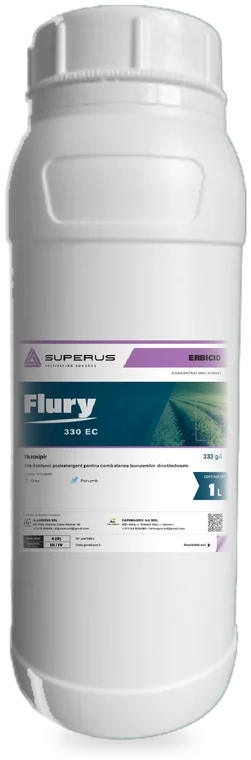
Flury 330 EC
Herbicide systémique de post-levée pour la lutte contre les dicotylédones.
 Blé
 Maïs
Mode d'emploi
Cultures, organismes cibles et doses. Respectez toujours l'étiquette du produit tel qu'il est homologué dans votre pays.
| Culture | Organisme cible | Dose (l/ha) | Application | DAR, jours (nb max. de traitements) | Délai de rentrée, jours manuel (mécanisé) |
|---|---|---|---|---|---|
| Blé | Dicotylédones annuelles et vivaces | 0,4-0,5 | Pulvériser sur la culture au stade tallage | - (1) | 7 (3) |
| Maïs | Dicotylédones annuelles et vivaces | 0,4-0,5 | Pulvérisation en post-levée (stade de la culture : 2-5 feuilles. Stade des adventices : 2-4 feuilles) | - (1) | 7 (3) |
Informations techniques
Mode d'action
Flury 330 EC is a selective, systemic, post-emergence herbicide containing fluroxypyr (pyridine carboxylic acids, synthetic auxin, HRAC 4). It is rapidly absorbed through the leaves and reaches the growing points. It causes uncontrolled growth of the tissues: leaves and stems twist, growth stops and the weeds die within 2-3 weeks. Very effective against cleavers, field bindweed and black bindweed; rain one hour after treatment does not reduce efficacy.
Propriétés physico-chimiques
Flury 330 EC is presented as a yellow emulsifiable concentrate (EC), containing fluroxypyr, 333 g/l (as fluroxypyr-meptyl, 480 g/l); the product is not corrosive.
Compatibilité
Flury 330 EC is compatible with most pesticides, but a compatibility test is recommended for each mixture. In wheat it can be combined with sulfonylurea herbicides to widen the spectrum.
Technique d'application
Sprayer: use a sprayer that ensures uniform distribution of the spray solution. Best efficacy – on young, actively growing weeds, above 10 °C. Fill 1/3 of the tank with water, add the product and, under continuous agitation, top up with water. Spray volume 200-300 l/ha.
Restrictions & limitations
Flury 330 EC must be used only on the registered crops. Pollution of water bodies must be avoided. In maize, do not apply if night temperatures fall below 6 °C. Replacement crops after: 5 weeks – cereals, maize, rapeseed; 10 weeks – sunflower, beet, potato, soybean, alfalfa; 15 weeks – pea, broad bean, clover. One treatment per season. Re-entry period: mechanised – 3 days, manual – 7 days.
Phytotoxicité
In maize – temporary slowing of growth. Very sensitive to drift: grapevine, hops, sunflower, beet, potato, legumes, vegetables.
Toxicité
Acute oral toxicity hazard category, human/bees: III / IV
- Classe de toxicité (homme / abeilles)
- III / IV
Sécurité, stockage & élimination
Classification & mentions de danger
Mention d'avertissement : Attention
Mentions de danger
- H317 — Peut provoquer une allergie cutanée.
- H319 — Provoque une sévère irritation des yeux.
- H335 — Peut irriter les voies respiratoires.
- H410 — Très toxique pour les organismes aquatiques, entraîne des effets néfastes à long terme.
- EUH401 — Respectez les instructions d'utilisation pour éviter les risques pour la santé humaine et l'environnement.
Conseils de prudence
- P102 — Tenir hors de portée des enfants.
- P261 — Éviter de respirer les poussières, fumées, gaz, brouillards, vapeurs, aérosols.
- P280 — Porter des gants de protection, des vêtements de protection, un équipement de protection des yeux et un équipement de protection du visage.
- P305+P351+P338 — EN CAS DE CONTACT AVEC LES YEUX: Rincer avec précaution à l'eau pendant plusieurs minutes. Enlever les lentilles de contact si la victime en porte et si elles peuvent être facilement enlevées. Continuer à rincer.
- P391 — Recueillir le produit répandu.
- P501 — Éliminer le contenu/récipient conformément à la réglementation locale.
Mesures de sécurité lors de l'application
Avoid contact with skin, eyes and clothing. Protective equipment and protective gloves must be worn during work. Use personal protective clothing. Keep work clothing separate. Adequate airing and ventilation of the workplace and storage area is required. Do not eat, drink or smoke when using this product. Hands and/or face must be washed before breaks and at the end of the working day. If medical advice is needed, have the product container or label at hand. Avoid breathing mist, vapours or spray. Do not take contaminated work clothing out of the workplace. After using the product, wash thoroughly any parts of the body that have been contaminated. Take off contaminated clothing and wash it before re-use. Read carefully and follow all instructions. Protective goggles and nitrile gloves must be worn; work outdoors or in well-ventilated areas (vapours may irritate the respiratory tract).
Premiers secours
In case of eye contact: rinse with plenty of clean water for at least 15 minutes, including under the eyelids. Remove contact lenses, if present. In case of skin contact: immediately remove contaminated clothing and wash the contaminated areas of the body with plenty of water. If irritation persists, seek medical advice. Wash contaminated clothing before re-use. If swallowed: give the casualty plenty of water to drink. Do not induce vomiting. Call a doctor immediately. If inhaled: move the casualty to fresh air. If breathing is irregular or has stopped, give artificial respiration. Seek medical attention if the casualty feels unwell. If swallowed, do NOT induce vomiting (the product contains a solvent); rinse the mouth and give the casualty a glass of water to drink, then call a doctor. THERE IS NO ANTIDOTE; TREAT SYMPTOMATICALLY.
Stockage & transport
Store the product in its original, sealed packaging, in dry rooms intended exclusively for pesticides, separately from food, beverages, tobacco products and animal feed. Protect from direct sunlight. Protect from temperatures below 0°C or above +35°C. During handling, transport and storage, occupational safety measures must be taken and the product must be protected from extreme temperature variations.
Élimination et décontamination des emballages
Prevent any possibility of product leakage, if this can be done safely. Do not discharge the product into surface waters or sewer systems. Contain the spill, then collect the accidentally spilled product by mechanical means and place it in suitable containers for subsequent disposal as hazardous waste. After removing the product, wash the spill site with water. If the product contaminates rivers, lakes or drains, inform the competent authorities. After emptying, rinse the containers three times and add the rinse water to the spray solution. Dispose of empty containers in accordance with the regulations in force. Do not re-use empty containers for any other purpose.
Inflammabilité
The product is not classified as a flammable liquid (flash point > 100 °C for the analogous product), but it is combustible. It is not explosive and has no oxidising properties. Extinguishing media: water spray, alcohol-resistant foam, dry chemical extinguisher or carbon dioxide. Firefighters: self-contained breathing apparatus. Thermal decomposition may generate: carbon oxides, nitrogen oxides, hydrochloric acid, hydrogen fluoride.