
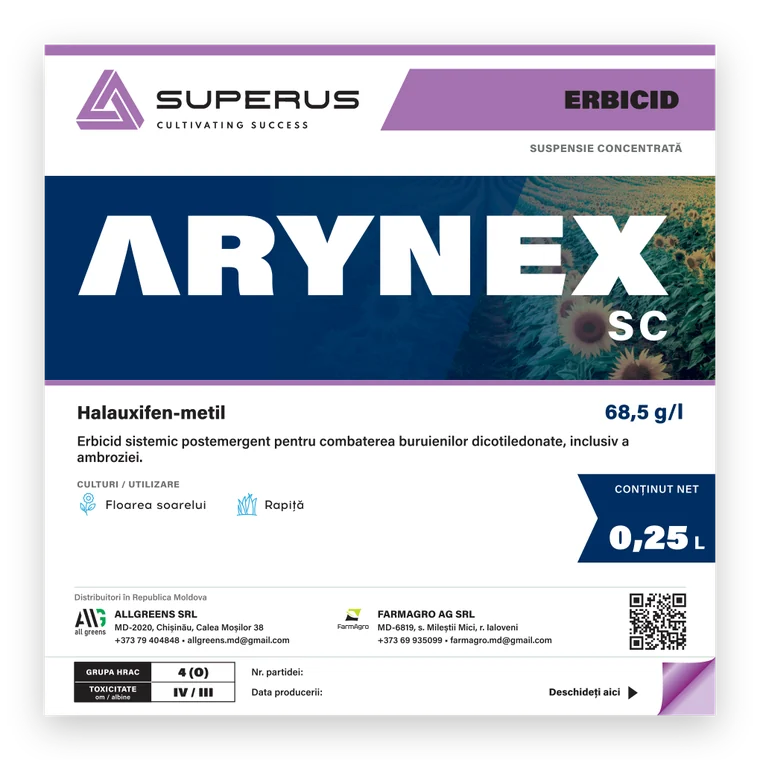
Arynex
Erbicida sistemico di post-emergenza per il controllo delle infestanti dicotiledoni, compresa l'ambrosia.
 Girasole
 Colza
Modalità d'impiego
Colture, organismi bersaglio e dosi. Attenersi sempre all'etichetta del prodotto registrato nel proprio Paese.
| Coltura | Avversità | Dose (l/ha) | Applicazione | Tempo di carenza, giorni (n. max trattamenti) | Tempo di rientro, giorni: lavori manuali (meccanizzati) |
|---|---|---|---|---|---|
| Girasole | Infestanti dicotiledoni annuali e perenni | 45ml + 0,2 Track | Trattamento fogliare della coltura dopo la comparsa della 4ª foglia della coltura (BBCH 14-18) o all'inizio della formazione dei bottoni fiorali (BBCH 30-50) | - (1) | - (3) |
| Colza | Infestanti dicotiledoni annuali | 0,065 - 0,070 + 0,2 Track | Trattamento fogliare della coltura in primavera, prima della comparsa dei bottoni fiorali (BBCH 30-50) | - (1) | - (3) |
Informazioni tecniche
Meccanismo d'azione
Arynex is a selective, systemic, post-emergence herbicide containing halauxifen-methyl (arylpicolinates, synthetic auxin, HRAC 4). It is absorbed through the leaves and accumulates in the growing points. It binds to the auxin receptors and disrupts growth: weeds stop growing within a few hours, then deformations, chlorosis and necrosis appear, and the weeds die within a few weeks. Very effective against ragweed, cornut, pigweed and velvetleaf.
Proprietà chimico-fisiche
Arynex is presented as a suspension concentrate (SC), containing halauxifen-methyl, 68,5 g/l; the product is not corrosive. Shake the container well before use.
Compatibilità
Arynex can be mixed with various products, after a compatibility test. It is applied with the adjuvant Track (see the table). Mixtures with many products should be avoided; in mixtures – only herbicides with a different mode of action.
Tecnica di applicazione
Sprayer: use a sprayer that ensures uniform distribution of the spray solution. Shake the container well. Fill 1/3 of the tank with water, add the product and, under continuous agitation, top up with water. Spray volume 100-400 l/ha. Immediately after treatment the sprayer is washed thoroughly.
Restrizioni e limitazioni
Arynex must be used only on the registered crops. Pollution of water bodies must be avoided; 15 m distance from surface waters. Do not apply below 5 °C or above 25 °C, when frost is imminent, to wet or weakened plants, or if it rains within the following 3 hours. Do not spray in wind above 15 km/h or during a temperature inversion. Re-entry period: mechanised – 3 days, manual – not regulated.
Fitotossicità
Not phytotoxic according to the label; small, transient chloroses (2-3 weeks) sometimes appear. Neighbouring broad-leaved crops are sensitive to drift.
Tossicità
Acute oral toxicity hazard category, human/bees: IV / III
- Classe di tossicità (uomo / api)
- IV / III
Sicurezza, conservazione e smaltimento
Classificazione e indicazioni di pericolo
Avvertenza: Attenzione
Indicazioni di pericolo
- H410 — Molto tossico per gli organismi acquatici con effetti di lunga durata.
- EUH401 — Per evitare rischi per la salute umana e per l'ambiente, seguire le istruzioni per l'uso.
Consigli di prudenza
- P102 — Tenere fuori dalla portata dei bambini.
- P273 — Non disperdere nell'ambiente.
- P391 — Raccogliere il materiale fuoriuscito.
- P501 — Smaltire il prodotto/recipiente in conformità alla normativa locale.
Misure di sicurezza durante l'applicazione
Avoid contact with skin, eyes and clothing. Protective equipment and protective gloves must be worn during work. Use personal protective clothing. Keep work clothing separate. Adequate airing and ventilation of the workplace and storage area is required. Do not eat, drink or smoke when using this product. Hands and/or face must be washed before breaks and at the end of the working day. If medical advice is needed, have the product container or label at hand. Avoid breathing mist, vapours or spray. Do not take contaminated work clothing out of the workplace. After using the product, wash thoroughly any parts of the body that have been contaminated. Take off contaminated clothing and wash it before re-use. Read carefully and follow all instructions.
Primo soccorso
In case of eye contact: rinse with plenty of clean water for at least 15 minutes, including under the eyelids. Remove contact lenses, if present. In case of skin contact: immediately remove contaminated clothing and wash the contaminated areas of the body with plenty of water. If irritation persists, seek medical advice. Wash contaminated clothing before re-use. If swallowed: give the casualty plenty of water to drink. Do not induce vomiting. Call a doctor immediately. If inhaled: move the casualty to fresh air. If breathing is irregular or has stopped, give artificial respiration. Seek medical attention if the casualty feels unwell. THERE IS NO ANTIDOTE; TREAT SYMPTOMATICALLY.
Conservazione e trasporto
Store the product in its original, sealed packaging, in dry rooms intended exclusively for pesticides, separately from food, beverages, tobacco products and animal feed. Protect from direct sunlight. Protect from temperatures below 0°C or above +35°C. During handling, transport and storage, occupational safety measures must be taken and the product must be protected from extreme temperature variations.
Smaltimento e decontaminazione degli imballaggi
Prevent any possibility of product leakage, if this can be done safely. Do not discharge the product into surface waters or sewer systems. Contain the spill, then collect the accidentally spilled product by mechanical means and place it in suitable containers for subsequent disposal as hazardous waste. After removing the product, wash the spill site with water. If the product contaminates rivers, lakes or drains, inform the competent authorities. After emptying, rinse the containers three times and add the rinse water to the spray solution. Dispose of empty containers in accordance with the regulations in force. Do not re-use empty containers for any other purpose.
Infiammabilità
The product is not explosive and has no oxidising properties. Extinguishing media: water spray, alcohol-resistant foam, dry chemical extinguisher or carbon dioxide. Firefighters must use self-contained breathing apparatus and full protective equipment. Thermal decomposition may generate: oxides of carbon, oxides of nitrogen, hydrochloric acid, hydrogen fluoride.