
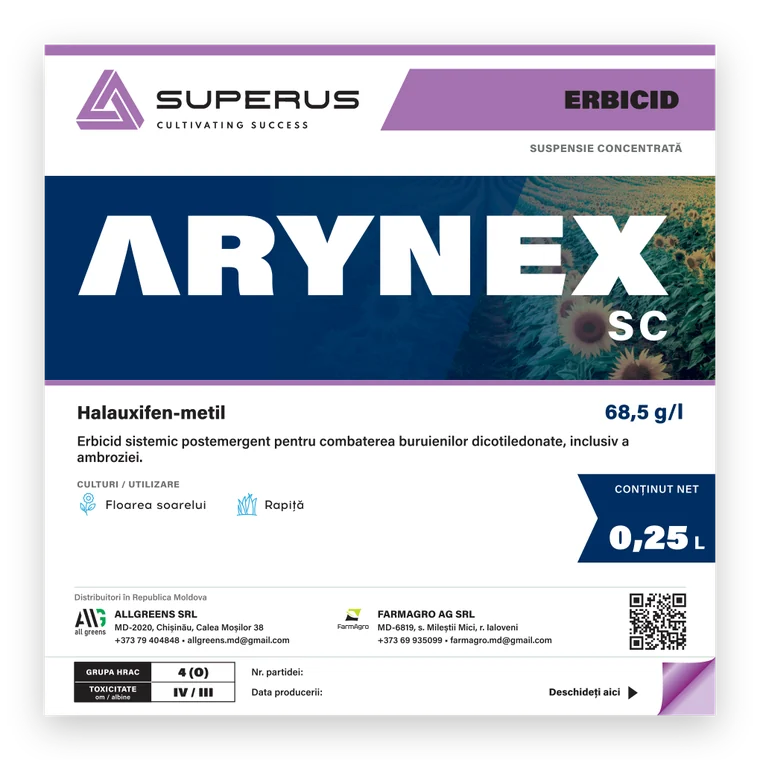
Arynex
Herbicyd systemiczny stosowany powschodowo do zwalczania chwastów dwuliściennych, w tym ambrozji.
 Słonecznik
 Rzepak
Instrukcja stosowania
Uprawy, zwalczane agrofagi i dawki. Należy zawsze stosować się do etykiety produktu zarejestrowanego w Państwa kraju.
| Uprawa | Zwalczany agrofag | Dawka (l/ha) | Stosowanie | Okres karencji, dni (maks. liczba zabiegów) | Okres prewencji, dni — prace ręczne (zmechanizowane) |
|---|---|---|---|---|---|
| Słonecznik | Chwasty dwuliścienne roczne i wieloletnie | 45ml + 0,2 Track | Opryskiwanie rośliny uprawnej po pojawieniu się 4. liścia (BBCH 14-18) lub na początku pąkowania (BBCH 30-50) | - (1) | - (3) |
| Rzepak | Chwasty dwuliścienne roczne | 0,065 - 0,070 + 0,2 Track | Opryskiwanie rośliny uprawnej wiosną, przed pojawieniem się pąków kwiatowych (BBCH 30-50) | - (1) | - (3) |
Informacje techniczne
Mechanizm działania
Arynex is a selective, systemic, post-emergence herbicide containing halauxifen-methyl (arylpicolinates, synthetic auxin, HRAC 4). It is absorbed through the leaves and accumulates in the growing points. It binds to the auxin receptors and disrupts growth: weeds stop growing within a few hours, then deformations, chlorosis and necrosis appear, and the weeds die within a few weeks. Very effective against ragweed, cornut, pigweed and velvetleaf.
Właściwości fizykochemiczne
Arynex is presented as a suspension concentrate (SC), containing halauxifen-methyl, 68,5 g/l; the product is not corrosive. Shake the container well before use.
Kompatybilność
Arynex can be mixed with various products, after a compatibility test. It is applied with the adjuvant Track (see the table). Mixtures with many products should be avoided; in mixtures – only herbicides with a different mode of action.
Technika stosowania
Sprayer: use a sprayer that ensures uniform distribution of the spray solution. Shake the container well. Fill 1/3 of the tank with water, add the product and, under continuous agitation, top up with water. Spray volume 100-400 l/ha. Immediately after treatment the sprayer is washed thoroughly.
Ograniczenia i zakazy
Arynex must be used only on the registered crops. Pollution of water bodies must be avoided; 15 m distance from surface waters. Do not apply below 5 °C or above 25 °C, when frost is imminent, to wet or weakened plants, or if it rains within the following 3 hours. Do not spray in wind above 15 km/h or during a temperature inversion. Re-entry period: mechanised – 3 days, manual – not regulated.
Fitotoksyczność
Not phytotoxic according to the label; small, transient chloroses (2-3 weeks) sometimes appear. Neighbouring broad-leaved crops are sensitive to drift.
Toksyczność
Acute oral toxicity hazard category, human/bees: IV / III
- Klasa toksyczności (człowiek / pszczoły)
- IV / III
Bezpieczeństwo, przechowywanie i utylizacja
Klasyfikacja i zwroty wskazujące rodzaj zagrożenia
Hasło ostrzegawcze: Uwaga
Zwroty wskazujące rodzaj zagrożenia
- H410 — Działa bardzo toksycznie na organizmy wodne, powodując długotrwałe skutki.
- EUH401 — W celu uniknięcia zagrożeń dla zdrowia ludzi i środowiska, należy postępować zgodnie z instrukcją użycia.
Zwroty wskazujące środki ostrożności
- P102 — Chronić przed dziećmi.
- P273 — Unikać uwolnienia do środowiska.
- P391 — Zebrać wyciek.
- P501 — Zawartość/pojemnik usuwać zgodnie z przepisami miejscowymi.
Środki bezpieczeństwa podczas stosowania
Avoid contact with skin, eyes and clothing. Protective equipment and protective gloves must be worn during work. Use personal protective clothing. Keep work clothing separate. Adequate airing and ventilation of the workplace and storage area is required. Do not eat, drink or smoke when using this product. Hands and/or face must be washed before breaks and at the end of the working day. If medical advice is needed, have the product container or label at hand. Avoid breathing mist, vapours or spray. Do not take contaminated work clothing out of the workplace. After using the product, wash thoroughly any parts of the body that have been contaminated. Take off contaminated clothing and wash it before re-use. Read carefully and follow all instructions.
Pierwsza pomoc
In case of eye contact: rinse with plenty of clean water for at least 15 minutes, including under the eyelids. Remove contact lenses, if present. In case of skin contact: immediately remove contaminated clothing and wash the contaminated areas of the body with plenty of water. If irritation persists, seek medical advice. Wash contaminated clothing before re-use. If swallowed: give the casualty plenty of water to drink. Do not induce vomiting. Call a doctor immediately. If inhaled: move the casualty to fresh air. If breathing is irregular or has stopped, give artificial respiration. Seek medical attention if the casualty feels unwell. THERE IS NO ANTIDOTE; TREAT SYMPTOMATICALLY.
Przechowywanie i transport
Store the product in its original, sealed packaging, in dry rooms intended exclusively for pesticides, separately from food, beverages, tobacco products and animal feed. Protect from direct sunlight. Protect from temperatures below 0°C or above +35°C. During handling, transport and storage, occupational safety measures must be taken and the product must be protected from extreme temperature variations.
Postępowanie z opakowaniami i dekontaminacja
Prevent any possibility of product leakage, if this can be done safely. Do not discharge the product into surface waters or sewer systems. Contain the spill, then collect the accidentally spilled product by mechanical means and place it in suitable containers for subsequent disposal as hazardous waste. After removing the product, wash the spill site with water. If the product contaminates rivers, lakes or drains, inform the competent authorities. After emptying, rinse the containers three times and add the rinse water to the spray solution. Dispose of empty containers in accordance with the regulations in force. Do not re-use empty containers for any other purpose.
Palność
The product is not explosive and has no oxidising properties. Extinguishing media: water spray, alcohol-resistant foam, dry chemical extinguisher or carbon dioxide. Firefighters must use self-contained breathing apparatus and full protective equipment. Thermal decomposition may generate: oxides of carbon, oxides of nitrogen, hydrochloric acid, hydrogen fluoride.