
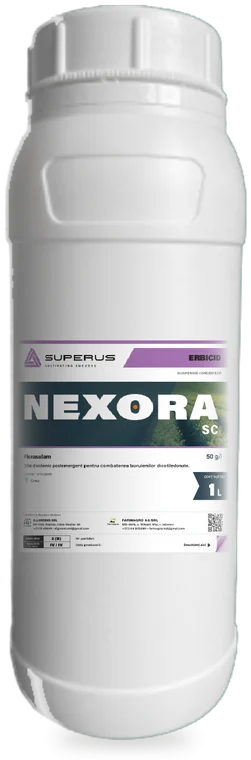
Nexora SC
Herbicyd systemiczny stosowany powschodowo do zwalczania chwastów dwuliściennych.
 Pszenica
Instrukcja stosowania
Uprawy, zwalczane agrofagi i dawki. Należy zawsze stosować się do etykiety produktu zarejestrowanego w Państwa kraju.
| Uprawa | Zwalczany agrofag | Dawka (l/ha) | Stosowanie | Okres karencji, dni (maks. liczba zabiegów) | Okres prewencji, dni — prace ręczne (zmechanizowane) |
|---|---|---|---|---|---|
| Pszenica | Chwasty dwuliścienne roczne i wieloletnie | 0,12-0,15 | Opryskiwanie rośliny uprawnej od fazy krzewienia do wykształcenia II międzywęźla | - (1) | - (3) |
Informacje techniczne
Mechanizm działania
Nexora SC is a selective, systemic, post-emergence herbicide containing florasulam, an active substance from the triazolopyrimidine group (HRAC 2). It is absorbed through the leaves and moves rapidly to the growing points. It inhibits the ALS enzyme, blocking the synthesis of branched-chain amino acids and cell division; weeds die within 7-10 days (under unfavourable conditions – 6-8 weeks). Effective also at low temperatures, especially against cleavers, chamomile and volunteer rapeseed.
Właściwości fizykochemiczne
Nexora SC is presented as a suspension concentrate (SC) containing florasulam, 50 g/l; the product is not corrosive. Shake the container well before use.
Kompatybilność
Nexora SC is compatible with most pesticides, but a compatibility test is recommended. To broaden the spectrum, it is preferably combined with herbicides with a different mode of action (e.g. synthetic auxins).
Technika stosowania
Use a sprayer that ensures uniform distribution of the solution. Shake the container well. Treatment is carried out in early spring, on young weeds (up to 6 leaves). Fill 1/3 of the tank with water, add the product and, with continuous agitation, top up with water. Spray volume 200-400 l/ha.
Ograniczenia i zakazy
Nexora SC must be used only on the registered crops. Pollution of water bodies must be avoided. Do not apply to wet or damaged plants, during drought, below 4 °C or above 25 °C, when frost is imminent, or in cereals with undersown legumes. No soil cultivation for 7 days before and after. One treatment per season. Re-entry period: mechanised – 3 days, manual – not regulated.
Fitotoksyczność
Not phytotoxic according to the label. Neighbouring broad-leaved crops (rapeseed, sunflower, beet, legumes, vegetables) are sensitive to drift.
Toksyczność
Acute oral toxicity hazard category, human/bees: IV / IV
- Klasa toksyczności (człowiek / pszczoły)
- IV / IV
Bezpieczeństwo, przechowywanie i utylizacja
Klasyfikacja i zwroty wskazujące rodzaj zagrożenia
Hasło ostrzegawcze: Uwaga
Zwroty wskazujące rodzaj zagrożenia
- H410 — Działa bardzo toksycznie na organizmy wodne, powodując długotrwałe skutki.
- EUH208 — Zawiera substancję uczulającą. Może powodować wystąpienie reakcji alergicznej.
- EUH401 — W celu uniknięcia zagrożeń dla zdrowia ludzi i środowiska, należy postępować zgodnie z instrukcją użycia.
Zwroty wskazujące środki ostrożności
- P102 — Chronić przed dziećmi.
- P273 — Unikać uwolnienia do środowiska.
- P280 — Stosować rękawice ochronne, odzież ochronną, ochronę oczu i ochronę twarzy.
- P391 — Zebrać wyciek.
- P501 — Zawartość/pojemnik usuwać zgodnie z przepisami miejscowymi.
Środki bezpieczeństwa podczas stosowania
Avoid contact with skin, eyes and clothing. Protective equipment and protective gloves must be worn during work. Use personal protective clothing. Keep work clothing separate. Adequate airing and ventilation of the workplace and storage area is required. Do not eat, drink or smoke when using this product. Hands and/or face must be washed before breaks and at the end of the working day. If medical advice is needed, have the product container or label at hand. Avoid breathing mist, vapours or spray. Do not take contaminated work clothing out of the workplace. After using the product, wash thoroughly any parts of the body that have been contaminated. Take off contaminated clothing and wash it before re-use. Read carefully and follow all instructions.
Pierwsza pomoc
In case of eye contact: rinse with plenty of clean water for at least 15 minutes, including under the eyelids. Remove contact lenses, if present. In case of skin contact: immediately remove contaminated clothing and wash the contaminated areas of the body with plenty of water. If irritation persists, seek medical advice. Wash contaminated clothing before re-use. If swallowed: give the casualty plenty of water to drink. Do not induce vomiting. Call a doctor immediately. If inhaled: move the casualty to fresh air. If breathing is irregular or has stopped, give artificial respiration. Seek medical attention if the casualty feels unwell. THERE IS NO ANTIDOTE; TREAT SYMPTOMATICALLY.
Przechowywanie i transport
Store the product in its original, sealed packaging, in dry rooms intended exclusively for pesticides, separately from food, beverages, tobacco products and animal feed. Protect from direct sunlight. Protect from temperatures below 0°C or above +35°C. During handling, transport and storage, occupational safety measures must be taken and the product must be protected from extreme temperature variations.
Postępowanie z opakowaniami i dekontaminacja
Prevent any possibility of product leakage, if this can be done safely. Do not discharge the product into surface waters or sewer systems. Contain the spill, then collect the accidentally spilled product by mechanical means and place it in suitable containers for subsequent disposal as hazardous waste. After removing the product, wash the spill site with water. If the product contaminates rivers, lakes or drains, inform the competent authorities. After emptying, rinse the containers three times and add the rinse water to the spray solution. Dispose of empty containers in accordance with the regulations in force. Do not re-use empty containers for any other purpose.
Palność
The product is not explosive and has no oxidising properties. Extinguishing media: water spray, alcohol-resistant foam, dry chemical extinguisher or carbon dioxide. Firefighters must use a self-contained breathing apparatus and full protective equipment. Thermal decomposition may generate: carbon oxides, nitrogen oxides, sulphur oxides, hydrogen fluoride.