
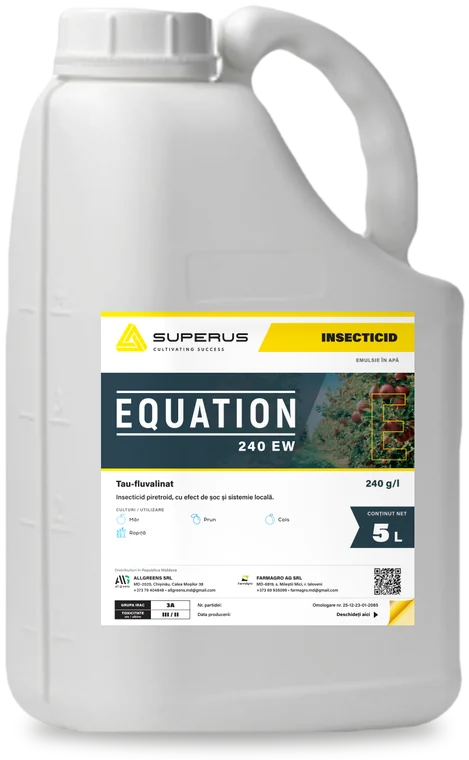
Equation 240 EW
Pyrethroid insecticide with knock-down effect and local systemic action.
 Apple
 Plum
 Apricot
 Rapeseed
Instructions for use
Crops, target organisms and rates. Always follow the label of the product as registered in your country.
| Crop | Target organism | Rate (l/ha) | Application | PHI, days (max. treatments) | Re-entry, days manual (mechanised) |
|---|---|---|---|---|---|
| Apple | Apple blossom beetle (Epicometis hirta) | 0,4 – 0,5 | Foliar spray during the flowering period | 30 (2) | 7 (3) |
| Plum | Plum fruit moth (Cydia funebrana) | 0,4 – 0,5 | Foliar spray during the flowering period | 30 (2) | 7 (3) |
| Apricot | Apple blossom beetle (Epicometis hirta) | 0,4 – 0,5 | Foliar spray during the flowering period | 30 (2) | 7 (3) |
| Rapeseed | Pollen beetle (Meligethes aeneus) | 0,2 – 0,3 | Foliar spray during the flowering period | 15 (2) | - (3) |
Technical information
Mode of action
Equation 240 EW is an insecticide/acaricide from the class of synthetic pyrethroids, with contact and ingestion effect. It acts by blocking the sodium channels in the nerve cells of insects and mites, prolonging their opening and causing nervous hyperactivity, paralysis and, finally, the death of the pest. Its rapid effect on the insect nervous system makes it effective in controlling pests resistant to other chemical classes. Tau-fluvalinate also has a repellent effect, reducing pest attack.
Physical & chemical properties
Equation 240 EW is a stable, concentrated liquid formulation, with limited water solubility but sufficient for field application. Its physico-chemical properties make it suitable for use as an insecticide/acaricide, with good handling and storage characteristics, but compliance with the storage conditions is recommended in order to maintain its efficacy.
Compatibility
Equation 240 EW is generally compatible with most fungicides and insecticides commonly used in agriculture. However, in order to avoid problems such as the formation of precipitates or loss of efficacy, it is recommended: – To test mixtures in small quantities before application in the main tank. – To avoid mixing with strongly alkaline products or with substances that may cause physical or chemical instability of the solution. – To follow the manufacturer's instructions regarding the order and method of tank mixing. – To pay attention to compatibility with certain foliar fertilisers, as incompatibilities may occur. In conclusion, tau-fluvalinate 240 g/l has good compatibility in most mixtures, but preliminary testing and compliance with the technical recommendations are essential for effective and safe use.
Application technique
Sprayer: use a sprayer that ensures uniform distribution of the spray solution. Application of treatments: use the required spray volume to achieve complete coverage of the plant surface. Spray volume – 800–1000 l/ha.
Restrictions & limitations
The product Equation 240 EW shall be used only on the registered crops and in accordance with the recommended use regulations. Pollution of water bodies with spray solution, as a result of run-off, disposal of leftover solution or washing of equipment, must be prevented. Re-entry interval for mechanised work – 3 days, for manual work – 7 days.
Phytotoxicity
At the recommended rates, the product Equation 240 EW has no phytotoxic action on agricultural crops.
Toxicity
Toxicity group III. Oral LD50 (rats) >2000 mg/kg. Dermal LD50 >2000 mg/kg. Not irritating to the skin. Irritating to the mucous membrane of the eye.
- Toxicity class (human / bees)
- III / II
- LD50 oral (rat)
- >2000 mg/kg
- LD50 dermal
- >2000 mg/kg
Safety, storage & disposal
Classification & hazard statements
Signal word: Warning
Hazard statements
- H410 — Very toxic to aquatic life with long lasting effects.
- EUH401 — To avoid risks to human health and the environment, comply with the instructions for use.
Precautionary statements
- P102 — Keep out of reach of children.
- P270 — Do not eat, drink or smoke when using this product.
- P273 — Avoid release to the environment.
- P280 — Wear protective gloves, protective clothing, eye protection and face protection.
- P391 — Collect spillage.
- P501 — Dispose of contents/container in accordance with local regulations.
Safety measures during application
Keep out of the reach of children! Observe occupational safety and hygiene measures! Avoid inhaling the spray solution in the form of dust or aerosol. Do not drink, eat or smoke while working with the product. When preparing the spray solution and during spraying, protective equipment must be worn (universal safety goggles, special clothing and footwear, gloves, respiratory protective equipment). After work, wash hands and exposed parts of the body thoroughly with soap and water.
First aid
In case of poisoning by ingestion, skin contact or inhalation, take the following measures: - Remove the casualty from the toxic or contaminated environment; - Remove contaminated clothing; - Wash the skin with plenty of soap and water; - Rinse the eyes, including under the eyelids, with water for at least 15 minutes; - If swallowed, rinse the mouth with water, do NOT induce vomiting; - Transport the casualty urgently to the nearest medical facility; - Symptomatic treatment under medical supervision. THERE ARE NO KNOWN ANTIDOTES.
Storage & transport
Store the product in its original, undamaged, labelled packaging, in locked, dry, cool, well-ventilated rooms, protected from direct heat and sunlight, out of the reach of children, separate from food and feed products. Transport protected from heat. During handling, transport and storage, all occupational safety and sanitary-hygiene measures must be taken. Empty containers shall not be used for any other purpose.
Packaging disposal & decontamination
Repeated use of the emptied container is prohibited! The emptied container shall not be discarded or used for any other purpose; destruction of the emptied container shall be carried out in special places designated for this purpose. Contamination of water reservoirs and other water sources with residues of the product and emptied containers is prohibited. If the product reaches the soil surface, its run-off into sewage networks and water reservoirs must be prevented. Contaminated soil shall be covered with sand or earth, then collected and buried in special places designated for this purpose.
Flammability
FLAMMABLE PRODUCT. In case of fire, use the following extinguishing media: water, foam, dry chemicals