
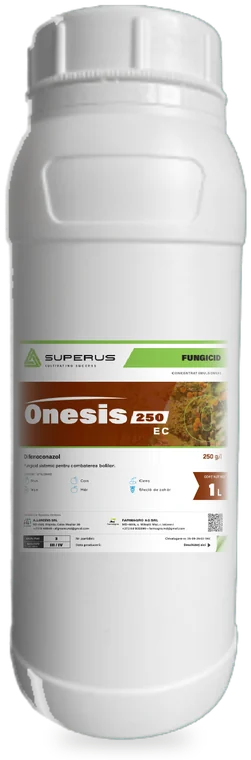
Onesis 250 EC
Systemic fungicide for the control of diseases.
 Plum
 Apricot
 Cherry
 Sour cherry
 Apple
 Sugar beet
Instructions for use
Crops, target organisms and rates. Always follow the label of the product as registered in your country.
| Crop | Target organism | Rate (l/ha) | Application | PHI, days (max. treatments) | Re-entry, days manual (mechanised) |
|---|---|---|---|---|---|
| Plum | Shot-hole disease (clasterosporium carpophilum) | 0,35-0,4 | Foliar spray during the flowering period | 20 (2) | 7 (3) |
| Apricot | Shot-hole disease (clasterosporium carpophilum) | 0,35-0,4 | Foliar spray during the flowering period | 20 (2) | 7 (3) |
| Cherry | Shot-hole disease (clasterosporium carpophilum) | 0,35-0,4 | Foliar spray during the flowering period | 20 (2) | 7 (3) |
| Sour cherry | Shot-hole disease (clasterosporium carpophilum) | 0,35-0,4 | Foliar spray during the flowering period | 20 (2) | 7 (3) |
| Apple | Scab (Venturia inaequalis, Venturia pirina) | 0,15-0,2 | Foliar spray during the growing season | 20(3-4) | 7(3) |
| Sugar beet | Cercospora leaf spot (Cercospora beticola) | 0,2-0,4 | Foliar spray during the growing season | 28(2) | 7(3) |
Technical information
Mode of action
Onesis 250 EC inhibits the biosynthesis of ergosterol, an essential component of the fungal cell membrane, stopping the development and spread of pathogens. It is effective against powdery mildew, scab, leaf spot and other foliar diseases. It is an emulsifiable concentrate, in the form of a clear yellowish-brown liquid, which is diluted in water for foliar applications. The active substance, difenoconazole, penetrates the plant and is distributed translaminarly and partly acropetally (via the sap), protecting the leaves and new shoots.
Physical & chemical properties
Onesis 250 EC has low water solubility, extremely low volatility and high affinity for lipids, which gives it good persistence on the leaves. It is stable under normal conditions, but very toxic to aquatic organisms, which is why it must be applied with caution.
Compatibility
Compatible with: -most fungicides (including systemic and contact fungicides), -some insecticides and acaricides (if the pH of the solution is neutral to slightly acidic). Incompatible with: -strongly alkaline products (e.g. concentrated Bordeaux mixture, some calcium-based preparations or strongly alkaline sulphates), -complex mixtures with many active substances at the same time (risk of precipitation or phytotoxicity).
Application technique
Sprayer: use a sprayer that ensures uniform distribution of the spray solution. Application of treatments: use the required spray volume to achieve complete coverage of the plant surface. Spray solution volume – 800-1000 l/ha.
Restrictions & limitations
Onesis 250 EC must be used only on the registered crops and in accordance with the recommended directions for use. Pollution of water bodies with spray solution as a result of run-off, disposal of leftover solution or washing of equipment must be avoided. Re-entry interval for mechanised work – 3 days, for manual work – 7 days.
Phytotoxicity
At the recommended doses, Onesis 250 EC has no phytotoxic effect on agricultural crops.
Toxicity
Toxicity group III. Oral LD50 (rats) >2000 mg/kg; dermal LD50 >2000 mg/kg. Non-irritating to skin. Irritating to the eye mucosa.
- Toxicity class (human / bees)
- III / IV
- LD50 oral (rat)
- >2000 mg/kg
- LD50 dermal
- >2000 mg/kg
Safety, storage & disposal
Classification & hazard statements
Signal word: Danger
Hazard statements
- H304 — May be fatal if swallowed and enters airways.
- H319 — Causes serious eye irritation.
- H351 — Suspected of causing cancer.
- H410 — Very toxic to aquatic life with long lasting effects.
- EUH066 — Repeated exposure may cause skin dryness or cracking.
- EUH401 — To avoid risks to human health and the environment, comply with the instructions for use.
Precautionary statements
- P102 — Keep out of reach of children.
- P280 — Wear protective gloves, protective clothing, eye protection and face protection.
- P301+P310 — IF SWALLOWED: Immediately call a POISON CENTER or doctor.
- P331 — Do NOT induce vomiting.
- P305+P351+P338 — IF IN EYES: Rinse cautiously with water for several minutes. Remove contact lenses, if present and easy to do. Continue rinsing.
- P308+P313 — IF exposed or concerned: Get medical advice/attention.
- P391 — Collect spillage.
- P501 — Dispose of contents/container in accordance with local regulations.
Safety measures during application
Keep out of the reach of children! Observe occupational safety and hygiene measures! Avoid inhaling the spray solution as dust or aerosol. Do not drink, eat or smoke while working with the product. When preparing the spray solution and during spraying, protective equipment must be worn (universal safety goggles, special clothing and footwear, gloves, respiratory protective equipment). After work, wash hands and exposed parts of the body thoroughly with soap and water.
First aid
-Remove the casualty from the toxic or contaminated environment; -Remove contaminated clothing; -Wash the skin with plenty of soap and water; -Rinse the eyes, including under the eyelids, with water for at least 15 minutes; -If swallowed, rinse the mouth with water, do NOT induce vomiting; -Transport the casualty urgently to the nearest medical facility; -Symptomatic treatment under medical supervision. THERE ARE NO KNOWN ANTIDOTES.
Storage & transport
Store the product in its original, undamaged, labelled packaging, in locked, dry, cool, well-ventilated rooms, protected from direct heat and sunlight, out of the reach of children and separately from food and feed. Transport protected from heat. During handling, transport and storage, all occupational safety and hygiene measures must be observed. Emptied containers must not be used for any other purpose.
Packaging disposal & decontamination
Re-use of emptied containers is prohibited! Emptied containers must not be discarded or used for any other purpose; emptied containers must be destroyed at special sites designated for this purpose. Contamination of water reservoirs and other water sources with residues of the product or emptied containers is prohibited. If the product is spilled on the soil surface, prevent it from running off into sewer systems or water reservoirs. Cover contaminated soil with sand or earth, then collect it and bury it at special sites designated for this purpose.
Flammability
NON-FLAMMABLE PRODUCT. In case of fire, use the following extinguishing media: water, foam, dry chemicals