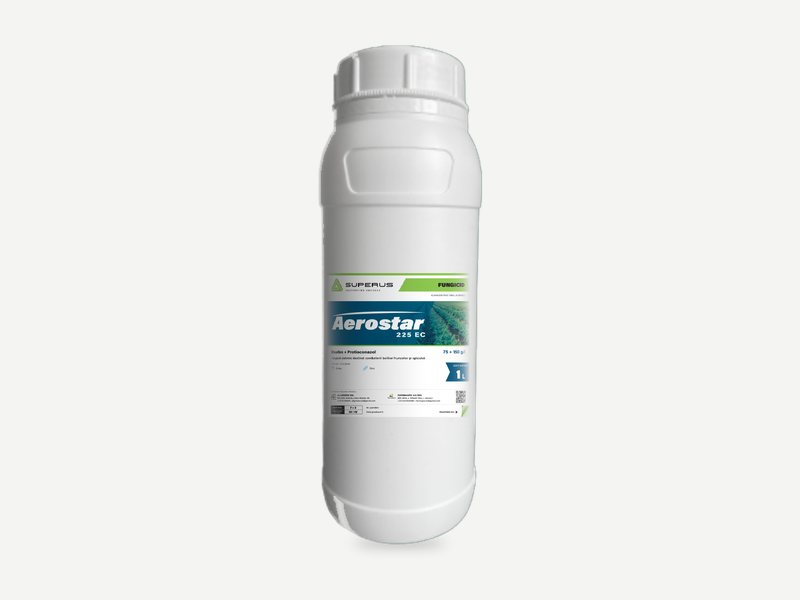

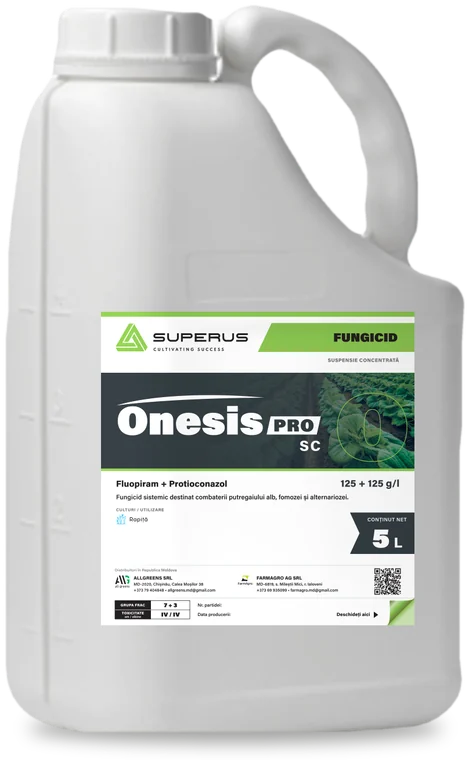
Onesis Pro SC
Systemic fungicide for the control of white mould, Phoma and Alternaria leaf spot.
 Rapeseed
Instructions for use
Crops, target organisms and rates. Always follow the label of the product as registered in your country.
| Crop | Target organism | Rate (l/ha) | Application | PHI, days (max. treatments) | Re-entry, days manual (mechanised) |
|---|---|---|---|---|---|
| Rapeseed | White mould / Sclerotinia rot, Phoma / blackleg, Alternaria leaf spot (Sclerotinia sclerotiorum, Phoma lingam, Alternaria brassicae) | 0,9-1,0 | Foliar spray during the growing season, from stem elongation until pod formation | 56 (2) | 7 (3) |
Technical information
Mode of action
Onesis Pro SC is a systemic fungicide that combines fluopyram (pyridinyl-ethyl-benzamide, SDHI, FRAC 7) and prothioconazole (triazolinthione, DMI, FRAC 3). Fluopyram blocks complex II of the mitochondrial respiratory chain of the fungus, stopping energy production, and prothioconazole inhibits ergosterol biosynthesis in the cell membrane. Both move acropetally and translaminarly, with preventive and curative action. The combination reduces the risk of resistance.
Physical & chemical properties
Onesis Pro SC is presented as a white to beige suspension concentrate containing fluopyram 125 g/l and prothioconazole 125 g/l. It is not flammable; it dilutes readily in water.
Compatibility
Onesis Pro SC is compatible with most common fungicides and insecticides in rapeseed. Do not mix with products with a strongly alkaline reaction. A compatibility test is required; the solution is used immediately.
Application technique
Sprayer: use a sprayer that ensures uniform distribution of the spray solution. Fill 1/2 of the tank with water, add the product and, with continuous agitation, top up with water. Spraying with fine droplets is recommended, at air temperatures of 12–20 °C. Spray volume – 200–400 l/ha.
Restrictions & limitations
The product Onesis Pro SC must be used only on the registered crops and in accordance with the regulations of use. In rapeseed – one treatment per season (SDHI anti-resistance strategy). Untreated buffer zone of 15 m from surface waters. During flowering, treatments are carried out outside the period of active bee flight. Re-entry period: mechanised work – 3 days, manual work – 7 days.
Phytotoxicity
At the recommended doses, the product Onesis Pro SC has no phytotoxic action on agricultural crops.
Toxicity
Acute oral toxicity hazard category, human/bees: IV / IV
- Toxicity class (human / bees)
- IV / IV
Safety, storage & disposal
Classification & hazard statements
Signal word: Warning
Hazard statements
- H410 — Very toxic to aquatic life with long lasting effects.
- EUH208 — Contains a sensitising substance. May produce an allergic reaction.
- EUH401 — To avoid risks to human health and the environment, comply with the instructions for use.
Precautionary statements
- P273 — Avoid release to the environment.
- P280 — Wear protective gloves, protective clothing, eye protection and face protection.
- P391 — Collect spillage.
- P410 — Protect from sunlight.
- P501 — Dispose of contents/container in accordance with local regulations.
Safety measures during application
Avoid contact with skin, eyes and clothing. Protective equipment and protective gloves must be worn during work. Use personal protective clothing. Keep work clothing separate. Adequate airing and ventilation of the workplace and storage area is required. Do not eat, drink or smoke when using this product. Hands and/or face must be washed before breaks and at the end of the working day. If medical advice is needed, have the product container or label at hand. Avoid breathing mist, vapours or spray. Do not take contaminated work clothing out of the workplace. After using the product, wash thoroughly any parts of the body that have been contaminated. Take off contaminated clothing and wash it before re-use. Read carefully and follow all instructions.
First aid
In case of eye contact: rinse with plenty of clean water for at least 15 minutes, including under the eyelids. Remove contact lenses, if present. In case of skin contact: immediately remove contaminated clothing and wash the contaminated areas of the body with plenty of water. If irritation persists, seek medical advice. Wash contaminated clothing before re-use. If swallowed: give the casualty plenty of water to drink. Do not induce vomiting. Call a doctor immediately. If inhaled: move the casualty to fresh air. If breathing is irregular or has stopped, give artificial respiration. Seek medical attention if the casualty feels unwell. If swallowed: rinse the mouth with water; do NOT induce vomiting; never give anything by mouth to an unconscious person; consult a doctor immediately and show the product label. THERE IS NO ANTIDOTE; TREAT SYMPTOMATICALLY.
Storage & transport
Store the product in its original, sealed packaging, in dry rooms intended exclusively for pesticides, separately from food, beverages, tobacco products and animal feed. Protect from direct sunlight. Protect from temperatures below 0°C or above +35°C. During handling, transport and storage, occupational safety measures must be taken and the product must be protected from extreme temperature variations. Store at temperatures between 0 and +30 °C, protected from sunlight.
Packaging disposal & decontamination
Prevent any possibility of product leakage, if this can be done safely. Do not discharge the product into surface waters or sewer systems. Contain the spill, then collect the accidentally spilled product by mechanical means and place it in suitable containers for subsequent disposal as hazardous waste. After removing the product, wash the spill site with water. If the product contaminates rivers, lakes or drains, inform the competent authorities. After emptying, rinse the containers three times and add the rinse water to the spray solution. Dispose of empty containers in accordance with the regulations in force. Do not re-use empty containers for any other purpose.
Flammability
NON-FLAMMABLE PRODUCT. The product is not explosive. In case of fire, use the following extinguishing media: water spray, foam, dry chemicals, carbon dioxide. Thermal decomposition may generate toxic gases (carbon oxides, nitrogen oxides); firefighters must wear self-contained breathing apparatus and full protective equipment.