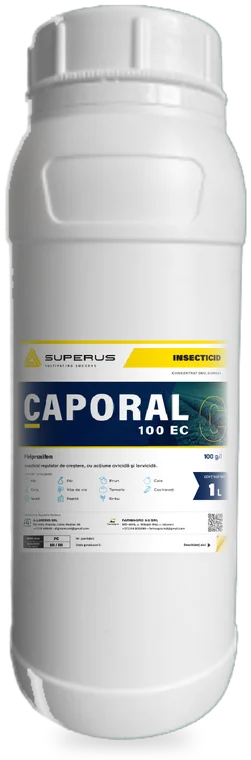
Caporal 100 EC
Insecticida regulador del crecimiento, con acción ovicida y larvicida.
 Manzano
 Peral
 Ciruelo
 Albaricoquero
 Cerezo
 Vid
 Tomate
 Pepino
 Col
 Colza
 Trigo
Instrucciones de uso
Cultivos, organismos diana y dosis. Siga siempre la etiqueta del producto tal como está registrado en su país.
| Cultivo | Organismo diana | Dosis (l/ha) | Aplicación | Plazo de seguridad, días (n.º máx. de tratamientos) | Reentrada, días manual (mecanizado) |
|---|---|---|---|---|---|
| Manzano | Piojo de San José, carpocapsa | 0,8-1,0 | Pulverización foliar a principios de primavera (estado de «punta verde») o a principios de verano (eclosión de las larvas migratorias) – contra el piojo de San José | 45 (1-2) | 7 (3) |
| Peral | Psila del peral | 1,0 | Pulverización foliar durante el periodo vegetativo (BBCH 51-75), desde la eclosión de las larvas hasta el estadio L3 | - (1) | 1 (1) |
| Ciruelo | Polilla del ciruelo, cochinilla del ciruelo, piojo de San José | 0,8-1,0 | Pulverización foliar durante el periodo vegetativo | 14 (2) | 7 (3) |
| Albaricoquero | Polilla oriental del melocotonero, pulgón verde del melocotonero, piojo de San José | 0,8-1,0 | Pulverización foliar durante el periodo vegetativo | 14 (2) | 7 (3) |
| Cerezo | Pulgón negro del cerezo, piojo de San José | 0,8-1,0 | Pulverización foliar durante el periodo vegetativo | 14 (2) | 7 (3) |
| Vid | Cochinilla del ciruelo | 0,8-1,0 | Pulverización foliar durante el periodo vegetativo | 21 (2) | 7 (3) |
| Tomate (cultivo protegido) | Mosca blanca de los invernaderos, mosca blanca del tabaco | 0,75-1,125 | Pulverización foliar durante el periodo vegetativo (BBCH 50-89), a la aparición de los primeros adultos | 3 (2) | - (-) |
| Pepino (cultivo protegido) | Mosca blanca de los invernaderos, mosca blanca del tabaco | 0,75-1,125 | Pulverización foliar durante el periodo vegetativo (BBCH 50-89), a la aparición de los primeros adultos | 3 (2) | - (-) |
| Col | Mosca blanca de los invernaderos | 0,8-1,0 | Pulverización foliar durante el periodo vegetativo | 14 (1-2) | 7 (3) |
| Colza | Meligetes, gorgojos, cecidómido de la colza | 0,5 | Pulverización foliar durante el periodo vegetativo | 28 (1-2) | - (3) |
| Trigo | Pulgones, trips del trigo, garrapatillo (chinche asiática de los cereales), criocero de los cereales | 0,4-0,5 | Pulverización foliar durante el periodo vegetativo | 28 (2-3) | - (3) |
Información técnica
Modo de acción
Caporal 100 EC is an insecticide from the group of insect growth regulators (juvenoids), with contact, ingestion and translaminar action. Pyriproxyfen mimics the juvenile hormone and blocks embryogenesis, moulting and metamorphosis: eggs do not hatch, larvae and nymphs do not reach adulthood, and exposed females lay non-viable eggs. It does not act on adults; it is applied when the first adults appear or at the beginning of larval hatching. Slow, long-lasting effect.
Propiedades físico-químicas
Caporal 100 EC is presented as an emulsifiable concentrate – a clear, yellow-brown liquid that forms a stable emulsion with water; it contains pyriproxyfen, 100 g/l.
Compatibilidad
Caporal 100 EC is compatible with most insecticides and fungicides, subject to a preliminary compatibility test. Do not mix with strongly alkaline products (Bordeaux mixture, calcium polysulphide).
Técnica de aplicación
Use a sprayer that ensures uniform distribution of the spray solution. Pour the product into the tank, partly filled with water, with the agitator running, then top up with water. Spray volume: 800-1000 l/ha for fruit trees and grapevine; 1000-1500 l/ha for tomato and cucumber in protected cultivation (0,075%); 200-400 l/ha for cabbage, rapeseed and wheat.
Restricciones y limitaciones
Caporal 100 EC is used only on the registered crops. Pollution of water bodies must be avoided. Do not exceed the maximum number of treatments given in the table; to prevent resistance, alternate with insecticides with a different mode of action. In protected structures pollinated by bumblebees, the hives are closed for the duration of the treatment. Re-entry period – as per the table.
Fitotoxicidad
Caporal 100 EC is not phytotoxic at the recommended doses. A trial treatment is recommended on vegetables in protected structures and on sensitive varieties.
Toxicidad
Acute oral toxicity hazard category, human/bees: III / III
- Clase de toxicidad (personas / abejas)
- III / III
Seguridad, almacenamiento y eliminación
Clasificación e indicaciones de peligro
Palabra de advertencia: Peligro
Indicaciones de peligro
- H304 — Puede ser mortal en caso de ingestión y penetración en las vías respiratorias.
- H318 — Provoca lesiones oculares graves.
- H336 — Puede provocar somnolencia o vértigo.
- H410 — Muy tóxico para los organismos acuáticos, con efectos nocivos duraderos.
- EUH066 — La exposición repetida puede provocar sequedad o formación de grietas en la piel.
- EUH401 — A fin de evitar riesgos para las personas y el medio ambiente, siga las instrucciones de uso.
Consejos de prudencia
- P280 — Llevar guantes de protección, prendas de protección, gafas de protección y máscara de protección.
- P301+P310 — EN CASO DE INGESTIÓN: Llamar inmediatamente a un CENTRO DE TOXICOLOGÍA o a un médico.
- P331 — NO provocar el vómito.
- P305+P351+P338 — EN CASO DE CONTACTO CON LOS OJOS: Aclarar cuidadosamente con agua durante varios minutos. Quitar las lentes de contacto, si lleva y resulta fácil. Seguir aclarando.
- P391 — Recoger el vertido.
- P501 — Eliminar el contenido/el recipiente conforme a la reglamentación local.
Medidas de seguridad durante la aplicación
Avoid contact with skin, eyes and clothing. Protective equipment and protective gloves must be worn during work. Use personal protective clothing. Keep work clothing separately. Adequate airing and ventilation of the workplace and storage area is required. Do not eat, drink or smoke when using this product. Hands and/or face must be washed before breaks and at the end of the working day. If medical advice is needed, have the product container or label at hand. Avoid breathing mist, vapours or spray. Do not take contaminated work clothing out of the workplace. After using the product, wash thoroughly any parts of the body that have been contaminated. Take off contaminated clothing and wash it before re-use. Read carefully and follow all instructions. Concentrate: tight-fitting goggles or face shield, chemical-resistant gloves, protective clothing. In greenhouses – good ventilation; access after the spray solution has dried.
Primeros auxilios
In case of eye contact: rinse with plenty of clean water for at least 15 minutes, including under the eyelids. Remove contact lenses, if present. In case of skin contact: immediately remove contaminated clothing and wash the contaminated areas of the body with plenty of water. If irritation persists, seek medical advice. Wash contaminated clothing before re-use. If swallowed: give the casualty plenty of water to drink. Do not induce vomiting. Call a doctor immediately. If inhaled: move the casualty to fresh air. If breathing is irregular or has stopped, give artificial respiration. Seek medical attention if the casualty feels unwell. Aspiration hazard (H304): if swallowed, do NOT induce vomiting, rinse the mouth and call a doctor immediately, showing the label. In case of eye contact: rinse immediately with plenty of water for at least 15 minutes and consult a doctor. THERE IS NO ANTIDOTE; TREAT SYMPTOMATICALLY.
Almacenamiento y transporte
Store the product in its original, sealed packaging, in dry rooms intended exclusively for pesticides, separately from food, beverages, tobacco products and animal feed. Protect from direct sunlight. Protect from temperatures below 0°C or above +35°C. During handling, transport and storage, occupational safety measures must be taken and the product must be protected from extreme temperature variations.
Eliminación y descontaminación de envases
Prevent any possibility of product leakage, if this can be done safely. Do not discharge the product into surface waters or sewer systems. Contain the spill, then collect the accidentally spilled product by mechanical means and place it in suitable containers for subsequent disposal as hazardous waste. After removing the product, wash the spill site with water. If the product contaminates rivers, lakes or drains, inform the competent authorities. After emptying, rinse the containers three times and add the rinse water to the spray solution. Dispose of empty containers in accordance with the regulations in force. Do not re-use empty containers for any other purpose.
Inflamabilidad
NON-FLAMMABLE PRODUCT (flash point of the analogue: 65 °C; combustible liquid). Keep away from sources of heat and open flame. In case of fire, use the following extinguishing media: water spray, foam, dry chemical powders, carbon dioxide; do not use a strong water jet. On burning, toxic fumes are released (carbon and nitrogen oxides) – use self-contained breathing apparatus.