
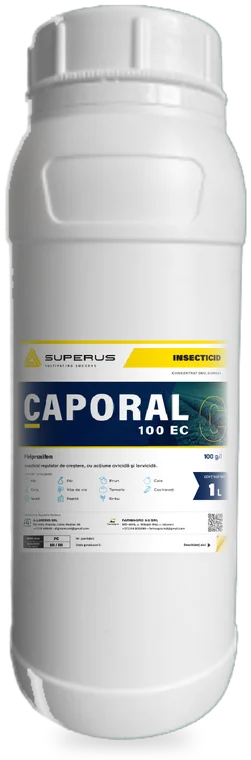
Caporal 100 EC
Insecticide régulateur de croissance à action ovicide et larvicide.
 Pommier
 Poirier
 Prunier
 Abricotier
 Cerisier
 Vigne
 Tomate
 Concombre
 Chou pommé
 Colza
 Blé
Mode d'emploi
Cultures, organismes cibles et doses. Respectez toujours l'étiquette du produit tel qu'il est homologué dans votre pays.
| Culture | Organisme cible | Dose (l/ha) | Application | DAR, jours (nb max. de traitements) | Délai de rentrée, jours manuel (mécanisé) |
|---|---|---|---|---|---|
| Pommier | Pou de San José, carpocapse | 0,8-1,0 | Pulvérisation au début du printemps (stade «pointe verte») ou au début de l'été (éclosion des larves mobiles) – contre le pou de San José | 45 (1-2) | 7 (3) |
| Poirier | Psylle du poirier | 1,0 | Pulvérisation foliaire pendant la période de végétation (BBCH 51-75), de l'éclosion des larves jusqu'au stade L3 | - (1) | 1 (1) |
| Prunier | Carpocapse des prunes, cochenille du prunier, pou de San José | 0,8-1,0 | Pulvérisation foliaire pendant la période de végétation | 14 (2) | 7 (3) |
| Abricotier | Tordeuse orientale du pêcher, puceron vert du pêcher, pou de San José | 0,8-1,0 | Pulvérisation foliaire pendant la période de végétation | 14 (2) | 7 (3) |
| Cerisier | Puceron noir du cerisier, pou de San José | 0,8-1,0 | Pulvérisation foliaire pendant la période de végétation | 14 (2) | 7 (3) |
| Vigne | Cochenille du prunier | 0,8-1,0 | Pulvérisation foliaire pendant la période de végétation | 21 (2) | 7 (3) |
| Tomate (cultures protégées) | Aleurode des serres, aleurode du tabac | 0,75-1,125 | Pulvérisation foliaire pendant la période de végétation (BBCH 50-89), à l'apparition des premiers adultes | 3 (2) | - (-) |
| Concombre (cultures protégées) | Aleurode des serres, aleurode du tabac | 0,75-1,125 | Pulvérisation foliaire pendant la période de végétation (BBCH 50-89), à l'apparition des premiers adultes | 3 (2) | - (-) |
| Chou pommé | Aleurode des serres | 0,8-1,0 | Pulvérisation foliaire pendant la période de végétation | 14 (1-2) | 7 (3) |
| Colza | Méligèthes, charançons, cécidomyie des siliques | 0,5 | Pulvérisation foliaire pendant la période de végétation | 28 (1-2) | - (3) |
| Blé | Pucerons, thrips du blé, punaise asiatique des céréales, criocère des céréales | 0,4-0,5 | Pulvérisation foliaire pendant la période de végétation | 28 (2-3) | - (3) |
Informations techniques
Mode d'action
Caporal 100 EC is an insecticide from the group of insect growth regulators (juvenoids), with contact, ingestion and translaminar action. Pyriproxyfen mimics the juvenile hormone and blocks embryogenesis, moulting and metamorphosis: eggs do not hatch, larvae and nymphs do not reach adulthood, and exposed females lay non-viable eggs. It does not act on adults; it is applied when the first adults appear or at the beginning of larval hatching. Slow, long-lasting effect.
Propriétés physico-chimiques
Caporal 100 EC is presented as an emulsifiable concentrate – a clear, yellow-brown liquid that forms a stable emulsion with water; it contains pyriproxyfen, 100 g/l.
Compatibilité
Caporal 100 EC is compatible with most insecticides and fungicides, subject to a preliminary compatibility test. Do not mix with strongly alkaline products (Bordeaux mixture, calcium polysulphide).
Technique d'application
Use a sprayer that ensures uniform distribution of the spray solution. Pour the product into the tank, partly filled with water, with the agitator running, then top up with water. Spray volume: 800-1000 l/ha for fruit trees and grapevine; 1000-1500 l/ha for tomato and cucumber in protected cultivation (0,075%); 200-400 l/ha for cabbage, rapeseed and wheat.
Restrictions & limitations
Caporal 100 EC is used only on the registered crops. Pollution of water bodies must be avoided. Do not exceed the maximum number of treatments given in the table; to prevent resistance, alternate with insecticides with a different mode of action. In protected structures pollinated by bumblebees, the hives are closed for the duration of the treatment. Re-entry period – as per the table.
Phytotoxicité
Caporal 100 EC is not phytotoxic at the recommended doses. A trial treatment is recommended on vegetables in protected structures and on sensitive varieties.
Toxicité
Acute oral toxicity hazard category, human/bees: III / III
- Classe de toxicité (homme / abeilles)
- III / III
Sécurité, stockage & élimination
Classification & mentions de danger
Mention d'avertissement : Danger
Mentions de danger
- H304 — Peut être mortel en cas d'ingestion et de pénétration dans les voies respiratoires.
- H318 — Provoque des lésions oculaires graves.
- H336 — Peut provoquer somnolence ou vertiges.
- H410 — Très toxique pour les organismes aquatiques, entraîne des effets néfastes à long terme.
- EUH066 — L'exposition répétée peut provoquer dessèchement ou gerçures de la peau.
- EUH401 — Respectez les instructions d'utilisation pour éviter les risques pour la santé humaine et l'environnement.
Conseils de prudence
- P280 — Porter des gants de protection, des vêtements de protection, un équipement de protection des yeux et un équipement de protection du visage.
- P301+P310 — EN CAS D'INGESTION: Appeler immédiatement un CENTRE ANTIPOISON ou un médecin.
- P331 — NE PAS faire vomir.
- P305+P351+P338 — EN CAS DE CONTACT AVEC LES YEUX: Rincer avec précaution à l'eau pendant plusieurs minutes. Enlever les lentilles de contact si la victime en porte et si elles peuvent être facilement enlevées. Continuer à rincer.
- P391 — Recueillir le produit répandu.
- P501 — Éliminer le contenu/récipient conformément à la réglementation locale.
Mesures de sécurité lors de l'application
Avoid contact with skin, eyes and clothing. Protective equipment and protective gloves must be worn during work. Use personal protective clothing. Keep work clothing separately. Adequate airing and ventilation of the workplace and storage area is required. Do not eat, drink or smoke when using this product. Hands and/or face must be washed before breaks and at the end of the working day. If medical advice is needed, have the product container or label at hand. Avoid breathing mist, vapours or spray. Do not take contaminated work clothing out of the workplace. After using the product, wash thoroughly any parts of the body that have been contaminated. Take off contaminated clothing and wash it before re-use. Read carefully and follow all instructions. Concentrate: tight-fitting goggles or face shield, chemical-resistant gloves, protective clothing. In greenhouses – good ventilation; access after the spray solution has dried.
Premiers secours
In case of eye contact: rinse with plenty of clean water for at least 15 minutes, including under the eyelids. Remove contact lenses, if present. In case of skin contact: immediately remove contaminated clothing and wash the contaminated areas of the body with plenty of water. If irritation persists, seek medical advice. Wash contaminated clothing before re-use. If swallowed: give the casualty plenty of water to drink. Do not induce vomiting. Call a doctor immediately. If inhaled: move the casualty to fresh air. If breathing is irregular or has stopped, give artificial respiration. Seek medical attention if the casualty feels unwell. Aspiration hazard (H304): if swallowed, do NOT induce vomiting, rinse the mouth and call a doctor immediately, showing the label. In case of eye contact: rinse immediately with plenty of water for at least 15 minutes and consult a doctor. THERE IS NO ANTIDOTE; TREAT SYMPTOMATICALLY.
Stockage & transport
Store the product in its original, sealed packaging, in dry rooms intended exclusively for pesticides, separately from food, beverages, tobacco products and animal feed. Protect from direct sunlight. Protect from temperatures below 0°C or above +35°C. During handling, transport and storage, occupational safety measures must be taken and the product must be protected from extreme temperature variations.
Élimination et décontamination des emballages
Prevent any possibility of product leakage, if this can be done safely. Do not discharge the product into surface waters or sewer systems. Contain the spill, then collect the accidentally spilled product by mechanical means and place it in suitable containers for subsequent disposal as hazardous waste. After removing the product, wash the spill site with water. If the product contaminates rivers, lakes or drains, inform the competent authorities. After emptying, rinse the containers three times and add the rinse water to the spray solution. Dispose of empty containers in accordance with the regulations in force. Do not re-use empty containers for any other purpose.
Inflammabilité
NON-FLAMMABLE PRODUCT (flash point of the analogue: 65 °C; combustible liquid). Keep away from sources of heat and open flame. In case of fire, use the following extinguishing media: water spray, foam, dry chemical powders, carbon dioxide; do not use a strong water jet. On burning, toxic fumes are released (carbon and nitrogen oxides) – use self-contained breathing apparatus.