

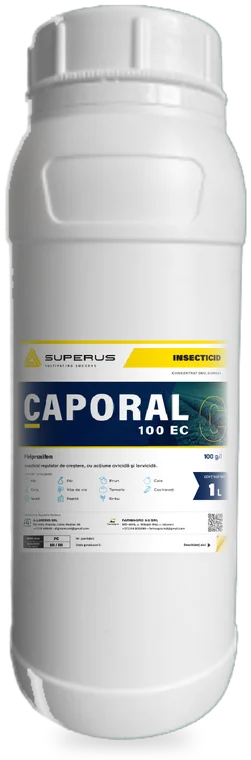
Caporal 100 EC
Insektycyd – regulator wzrostu owadów o działaniu jajobójczym i larwobójczym.
 Jabłoń
 Grusza
 Śliwa
 Morela
 Czereśnia
 Winorośl
 Pomidor
 Ogórek
 Kapusta głowiasta
 Rzepak
 Pszenica
Instrukcja stosowania
Uprawy, zwalczane agrofagi i dawki. Należy zawsze stosować się do etykiety produktu zarejestrowanego w Państwa kraju.
| Uprawa | Zwalczany agrofag | Dawka (l/ha) | Stosowanie | Okres karencji, dni (maks. liczba zabiegów) | Okres prewencji, dni — prace ręczne (zmechanizowane) |
|---|---|---|---|---|---|
| Jabłoń | Tarcznik niszczyciel (San José), owocówka jabłkóweczka | 0,8-1,0 | Opryskiwanie wczesną wiosną (faza „zielonego stożka”) lub na początku lata (wylęg larw wędrujących) – przeciwko tarcznikowi niszczycielowi (San José) | 45 (1-2) | 7 (3) |
| Grusza | Miodówka gruszowa | 1,0 | Opryskiwanie w okresie wegetacji (BBCH 51-75), od wylęgu larw do trzeciego stadium larwalnego (L3) | - (1) | 1 (1) |
| Śliwa | Owocówka śliwkóweczka, czerwiec śliwowiec, tarcznik niszczyciel (San José) | 0,8-1,0 | Opryskiwanie w okresie wegetacji | 14 (2) | 7 (3) |
| Morela | Owocówka wschodnia, mszyca brzoskwiniowa, tarcznik niszczyciel (San José) | 0,8-1,0 | Opryskiwanie w okresie wegetacji | 14 (2) | 7 (3) |
| Czereśnia | Czarna mszyca czereśniowa, tarcznik niszczyciel (San José) | 0,8-1,0 | Opryskiwanie w okresie wegetacji | 14 (2) | 7 (3) |
| Winorośl | Czerwiec śliwowiec | 0,8-1,0 | Opryskiwanie w okresie wegetacji | 21 (2) | 7 (3) |
| Pomidor (uprawa pod osłonami) | Mączlik szklarniowy, mączlik tytoniowy | 0,75-1,125 | Opryskiwanie w okresie wegetacji (BBCH 50-89), po pojawieniu się pierwszych owadów dorosłych | 3 (2) | - (-) |
| Ogórek (uprawa pod osłonami) | Mączlik szklarniowy, mączlik tytoniowy | 0,75-1,125 | Opryskiwanie w okresie wegetacji (BBCH 50-89), po pojawieniu się pierwszych owadów dorosłych | 3 (2) | - (-) |
| Kapusta głowiasta | Mączlik szklarniowy | 0,8-1,0 | Opryskiwanie w okresie wegetacji | 14 (1-2) | 7 (3) |
| Rzepak | Słodyszek rzepakowy, ryjkowce, pryszczarek kapustnik | 0,5 | Opryskiwanie w okresie wegetacji | 28 (1-2) | - (3) |
| Pszenica | Mszyce, wciornastek pszenicznik, żółwinek zbożowy, skrzypionka zbożowa | 0,4-0,5 | Opryskiwanie w okresie wegetacji | 28 (2-3) | - (3) |
Informacje techniczne
Mechanizm działania
Caporal 100 EC is an insecticide from the group of insect growth regulators (juvenoids), with contact, ingestion and translaminar action. Pyriproxyfen mimics the juvenile hormone and blocks embryogenesis, moulting and metamorphosis: eggs do not hatch, larvae and nymphs do not reach adulthood, and exposed females lay non-viable eggs. It does not act on adults; it is applied when the first adults appear or at the beginning of larval hatching. Slow, long-lasting effect.
Właściwości fizykochemiczne
Caporal 100 EC is presented as an emulsifiable concentrate – a clear, yellow-brown liquid that forms a stable emulsion with water; it contains pyriproxyfen, 100 g/l.
Kompatybilność
Caporal 100 EC is compatible with most insecticides and fungicides, subject to a preliminary compatibility test. Do not mix with strongly alkaline products (Bordeaux mixture, calcium polysulphide).
Technika stosowania
Use a sprayer that ensures uniform distribution of the spray solution. Pour the product into the tank, partly filled with water, with the agitator running, then top up with water. Spray volume: 800-1000 l/ha for fruit trees and grapevine; 1000-1500 l/ha for tomato and cucumber in protected cultivation (0,075%); 200-400 l/ha for cabbage, rapeseed and wheat.
Ograniczenia i zakazy
Caporal 100 EC is used only on the registered crops. Pollution of water bodies must be avoided. Do not exceed the maximum number of treatments given in the table; to prevent resistance, alternate with insecticides with a different mode of action. In protected structures pollinated by bumblebees, the hives are closed for the duration of the treatment. Re-entry period – as per the table.
Fitotoksyczność
Caporal 100 EC is not phytotoxic at the recommended doses. A trial treatment is recommended on vegetables in protected structures and on sensitive varieties.
Toksyczność
Acute oral toxicity hazard category, human/bees: III / III
- Klasa toksyczności (człowiek / pszczoły)
- III / III
Bezpieczeństwo, przechowywanie i utylizacja
Klasyfikacja i zwroty wskazujące rodzaj zagrożenia
Hasło ostrzegawcze: Niebezpieczeństwo
Zwroty wskazujące rodzaj zagrożenia
- H304 — Połknięcie i dostanie się przez drogi oddechowe może grozić śmiercią.
- H318 — Powoduje poważne uszkodzenie oczu.
- H336 — Może wywoływać uczucie senności lub zawroty głowy.
- H410 — Działa bardzo toksycznie na organizmy wodne, powodując długotrwałe skutki.
- EUH066 — Powtarzające się narażenie może powodować wysuszanie lub pękanie skóry.
- EUH401 — W celu uniknięcia zagrożeń dla zdrowia ludzi i środowiska, należy postępować zgodnie z instrukcją użycia.
Zwroty wskazujące środki ostrożności
- P280 — Stosować rękawice ochronne, odzież ochronną, ochronę oczu i ochronę twarzy.
- P301+P310 — W PRZYPADKU POŁKNIĘCIA: Natychmiast skontaktować się z OŚRODKIEM ZATRUĆ/lekarzem.
- P331 — NIE wywoływać wymiotów.
- P305+P351+P338 — W PRZYPADKU DOSTANIA SIĘ DO OCZU: Ostrożnie płukać wodą przez kilka minut. Wyjąć soczewki kontaktowe, jeżeli są i można je łatwo usunąć. Nadal płukać.
- P391 — Zebrać wyciek.
- P501 — Zawartość/pojemnik usuwać zgodnie z przepisami miejscowymi.
Środki bezpieczeństwa podczas stosowania
Avoid contact with skin, eyes and clothing. Protective equipment and protective gloves must be worn during work. Use personal protective clothing. Keep work clothing separately. Adequate airing and ventilation of the workplace and storage area is required. Do not eat, drink or smoke when using this product. Hands and/or face must be washed before breaks and at the end of the working day. If medical advice is needed, have the product container or label at hand. Avoid breathing mist, vapours or spray. Do not take contaminated work clothing out of the workplace. After using the product, wash thoroughly any parts of the body that have been contaminated. Take off contaminated clothing and wash it before re-use. Read carefully and follow all instructions. Concentrate: tight-fitting goggles or face shield, chemical-resistant gloves, protective clothing. In greenhouses – good ventilation; access after the spray solution has dried.
Pierwsza pomoc
In case of eye contact: rinse with plenty of clean water for at least 15 minutes, including under the eyelids. Remove contact lenses, if present. In case of skin contact: immediately remove contaminated clothing and wash the contaminated areas of the body with plenty of water. If irritation persists, seek medical advice. Wash contaminated clothing before re-use. If swallowed: give the casualty plenty of water to drink. Do not induce vomiting. Call a doctor immediately. If inhaled: move the casualty to fresh air. If breathing is irregular or has stopped, give artificial respiration. Seek medical attention if the casualty feels unwell. Aspiration hazard (H304): if swallowed, do NOT induce vomiting, rinse the mouth and call a doctor immediately, showing the label. In case of eye contact: rinse immediately with plenty of water for at least 15 minutes and consult a doctor. THERE IS NO ANTIDOTE; TREAT SYMPTOMATICALLY.
Przechowywanie i transport
Store the product in its original, sealed packaging, in dry rooms intended exclusively for pesticides, separately from food, beverages, tobacco products and animal feed. Protect from direct sunlight. Protect from temperatures below 0°C or above +35°C. During handling, transport and storage, occupational safety measures must be taken and the product must be protected from extreme temperature variations.
Postępowanie z opakowaniami i dekontaminacja
Prevent any possibility of product leakage, if this can be done safely. Do not discharge the product into surface waters or sewer systems. Contain the spill, then collect the accidentally spilled product by mechanical means and place it in suitable containers for subsequent disposal as hazardous waste. After removing the product, wash the spill site with water. If the product contaminates rivers, lakes or drains, inform the competent authorities. After emptying, rinse the containers three times and add the rinse water to the spray solution. Dispose of empty containers in accordance with the regulations in force. Do not re-use empty containers for any other purpose.
Palność
NON-FLAMMABLE PRODUCT (flash point of the analogue: 65 °C; combustible liquid). Keep away from sources of heat and open flame. In case of fire, use the following extinguishing media: water spray, foam, dry chemical powders, carbon dioxide; do not use a strong water jet. On burning, toxic fumes are released (carbon and nitrogen oxides) – use self-contained breathing apparatus.
Więcej: insektycydy i akarycydy
 Insektycyd
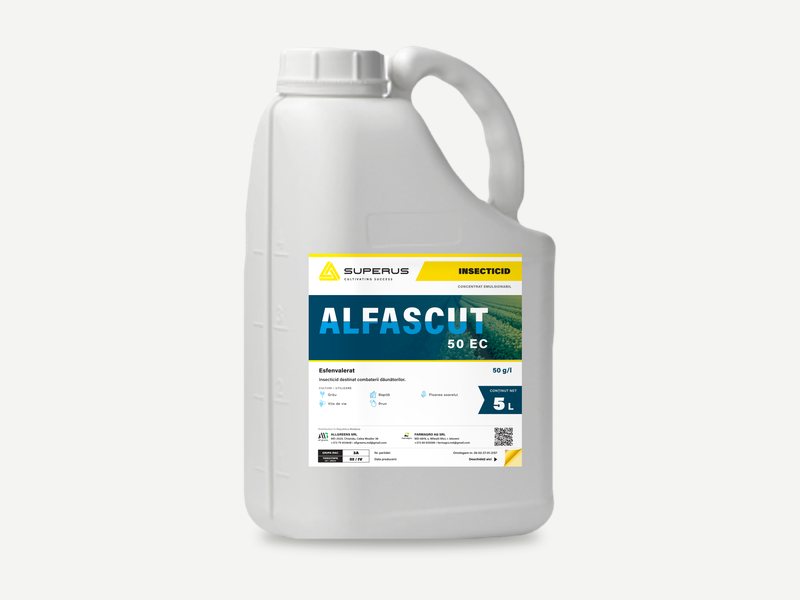
Alfascut 50 EC
 Insektycyd
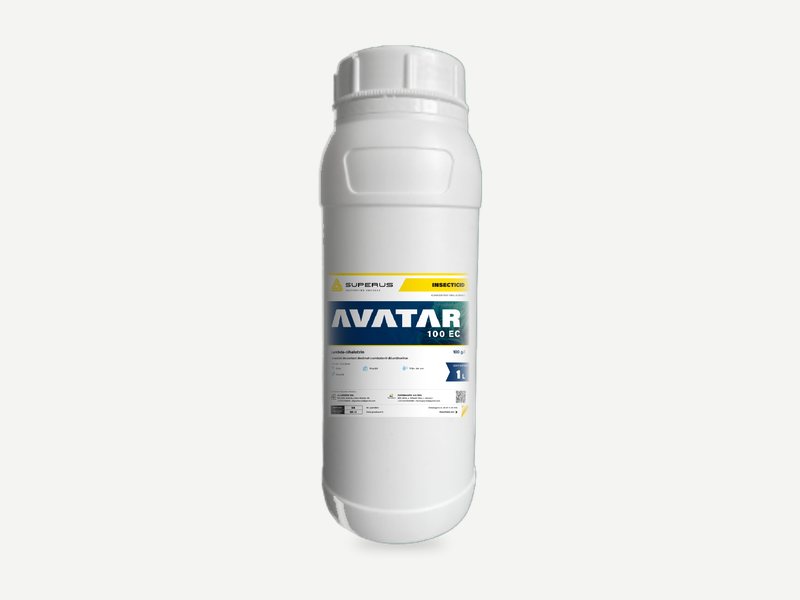
Avatar 100 EC
 Insektycyd